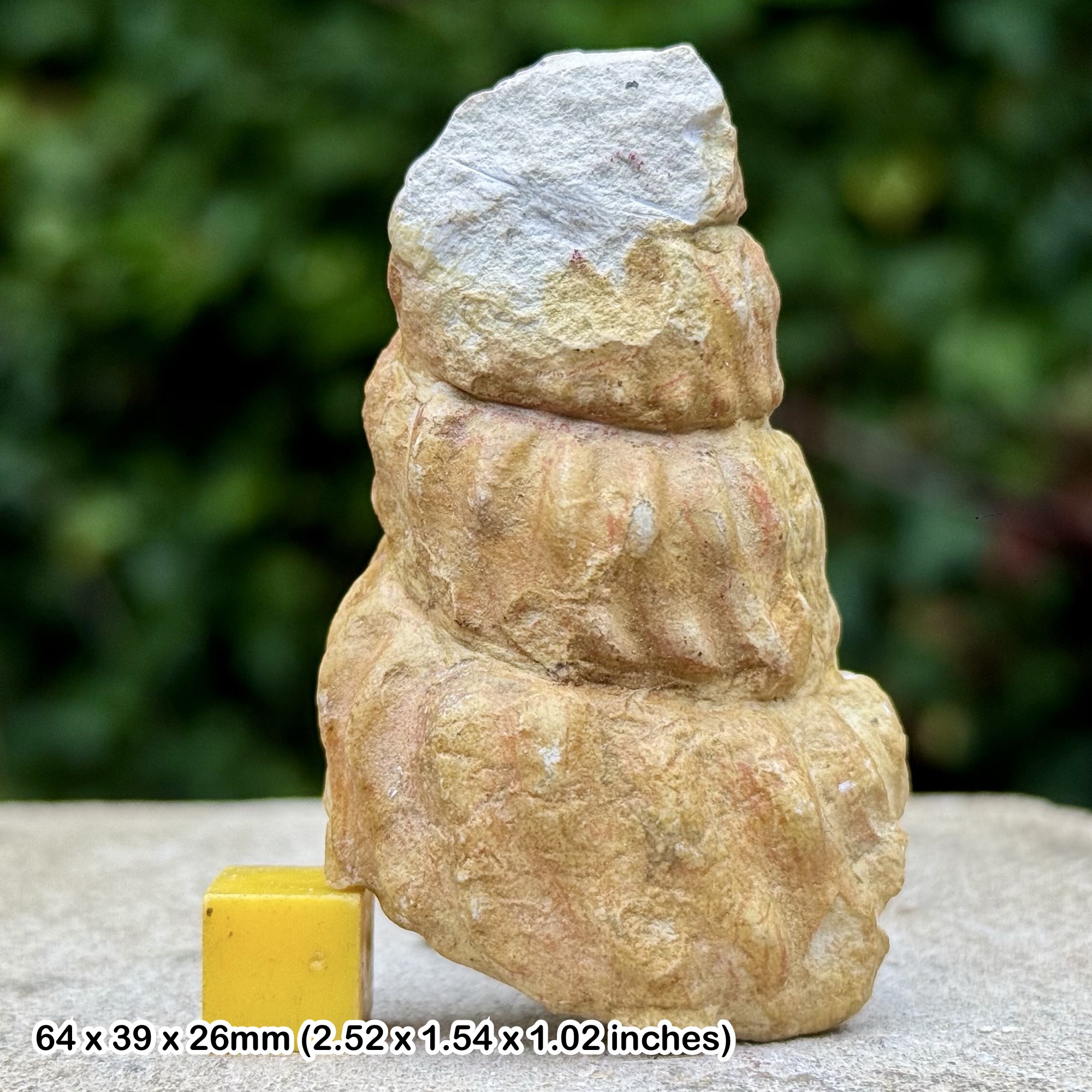
Turrilites acutus Heteromorph Fossil Ammonite Cenomanian Cretaceous Sussex United Kingdom with COA
£ 18.00
TURRILITES ACUTUS HETEROMORPH AMMONITE FROM SUSSEXOffered here is a Turrilites acutus heteromorph fossil ammonite, discovered in
the Cenomanian chalk deposits of Sussex, United Kingdom. Dating to the Late Cretaceous Period, approximately 100–94 million years ago, this ammonite represents one of the most distinctive heteromorph species, characterised by its turret-like coiling and sharply defined ribbing. Rare and scientifically significant, Turrilites acutus is highly prized by both collectors and researchers.All fossils supplied are 100% genuine specimens and come with a Certificate of Authenticity. The exact specimen shown in the photographs is the one you will receive, with a 1cm scale cube and rule squares provided for accurate sizing reference. GEOLOGICAL AGE AND PROVENANCEThis specimen originates from the Cenomanian Stage, the earliest stage of the Late Cretaceous. The Cenomanian was a time of elevated global sea levels when shallow epicontinental seas spread across Europe. These marine environments supported diverse populations of ammonites, with heteromorph forms like Turrilites acutus serving as key evolutionary lineages.The chalk formations of Sussex are world-renowned fossil localities, forming part of the famous White Chalk cliffs of southern England. They have been central to palaeontological study since the early 19th century, providing material for many scientific descriptions. Fossils of Turrilites acutus from Sussex are considered reference material for Cenomanian stratigraphy. FOSSIL TYPE AND SCIENTIFIC CLASSIFICATION
• Genus: Turrilites
• Species: Turrilites acutus
• Order: Ammonitida
• Superfamily: Turrilitoidea
• Family: TurrilitidaeTurrilites acutus is a key index fossil of the Cenomanian Stage. Its restricted distribution and easily recognisable morphology make it invaluable for biostratigraphy, enabling geologists to precisely date and correlate Cenomanian deposits across Europe. MORPHOLOGICAL FEATURESThe species Turrilites acutus can be identified by its diagnostic shell structure:
• Helicoidal Coiling: The shell grows in a vertical, turret-like spiral rather than a flat coil.
• Strong Ribbing: Sharply defined ribs encircle the shell, giving the species its name “acutus,” meaning sharp.
• Tubercles: Small nodules often appear along the ribs, adding diagnostic texture.
• Keel Development: A keel typically runs along the venter, enhancing both stability and identification.These features not only define the species but also create a fossil of remarkable aesthetic appeal. SCIENTIFIC AND COLLECTOR IMPORTANCETurrilites acutus plays an essential role in Cenomanian biostratigraphy, defining the acutus Zone of the Lower Cenomanian. Its presence allows for precise correlation between chalk deposits across Europe, making it a species of significant scientific importance.Collectors value Turrilites acutus for its rarity, unusual heteromorph form, and its association with one of the most famous fossil-bearing regions in the world. Well-preserved examples such as this are increasingly scarce, further enhancing their desirability. DISPLAY AND EDUCATIONAL VALUEThis specimen has been carefully chosen for its preservation and strong rib detail, making it both scientifically informative and visually striking. Its unusual turret-like form makes it stand out in any collection, providing an excellent teaching example of ammonite diversity and evolutionary experimentation.Perfect for museum exhibits, educational institutions, or private fossil collections, this Turrilites acutus ammonite from Sussex represents both the beauty and the scientific importance of the Cretaceous fossil record. Owning such a specimen provides a tangible connection to the Cenomanian seas of southern England more than 95 million years ago.
the Cenomanian chalk deposits of Sussex, United Kingdom. Dating to the Late Cretaceous Period, approximately 100–94 million years ago, this ammonite represents one of the most distinctive heteromorph species, characterised by its turret-like coiling and sharply defined ribbing. Rare and scientifically significant, Turrilites acutus is highly prized by both collectors and researchers.All fossils supplied are 100% genuine specimens and come with a Certificate of Authenticity. The exact specimen shown in the photographs is the one you will receive, with a 1cm scale cube and rule squares provided for accurate sizing reference. GEOLOGICAL AGE AND PROVENANCEThis specimen originates from the Cenomanian Stage, the earliest stage of the Late Cretaceous. The Cenomanian was a time of elevated global sea levels when shallow epicontinental seas spread across Europe. These marine environments supported diverse populations of ammonites, with heteromorph forms like Turrilites acutus serving as key evolutionary lineages.The chalk formations of Sussex are world-renowned fossil localities, forming part of the famous White Chalk cliffs of southern England. They have been central to palaeontological study since the early 19th century, providing material for many scientific descriptions. Fossils of Turrilites acutus from Sussex are considered reference material for Cenomanian stratigraphy. FOSSIL TYPE AND SCIENTIFIC CLASSIFICATION
• Genus: Turrilites
• Species: Turrilites acutus
• Order: Ammonitida
• Superfamily: Turrilitoidea
• Family: TurrilitidaeTurrilites acutus is a key index fossil of the Cenomanian Stage. Its restricted distribution and easily recognisable morphology make it invaluable for biostratigraphy, enabling geologists to precisely date and correlate Cenomanian deposits across Europe. MORPHOLOGICAL FEATURESThe species Turrilites acutus can be identified by its diagnostic shell structure:
• Helicoidal Coiling: The shell grows in a vertical, turret-like spiral rather than a flat coil.
• Strong Ribbing: Sharply defined ribs encircle the shell, giving the species its name “acutus,” meaning sharp.
• Tubercles: Small nodules often appear along the ribs, adding diagnostic texture.
• Keel Development: A keel typically runs along the venter, enhancing both stability and identification.These features not only define the species but also create a fossil of remarkable aesthetic appeal. SCIENTIFIC AND COLLECTOR IMPORTANCETurrilites acutus plays an essential role in Cenomanian biostratigraphy, defining the acutus Zone of the Lower Cenomanian. Its presence allows for precise correlation between chalk deposits across Europe, making it a species of significant scientific importance.Collectors value Turrilites acutus for its rarity, unusual heteromorph form, and its association with one of the most famous fossil-bearing regions in the world. Well-preserved examples such as this are increasingly scarce, further enhancing their desirability. DISPLAY AND EDUCATIONAL VALUEThis specimen has been carefully chosen for its preservation and strong rib detail, making it both scientifically informative and visually striking. Its unusual turret-like form makes it stand out in any collection, providing an excellent teaching example of ammonite diversity and evolutionary experimentation.Perfect for museum exhibits, educational institutions, or private fossil collections, this Turrilites acutus ammonite from Sussex represents both the beauty and the scientific importance of the Cretaceous fossil record. Owning such a specimen provides a tangible connection to the Cenomanian seas of southern England more than 95 million years ago.