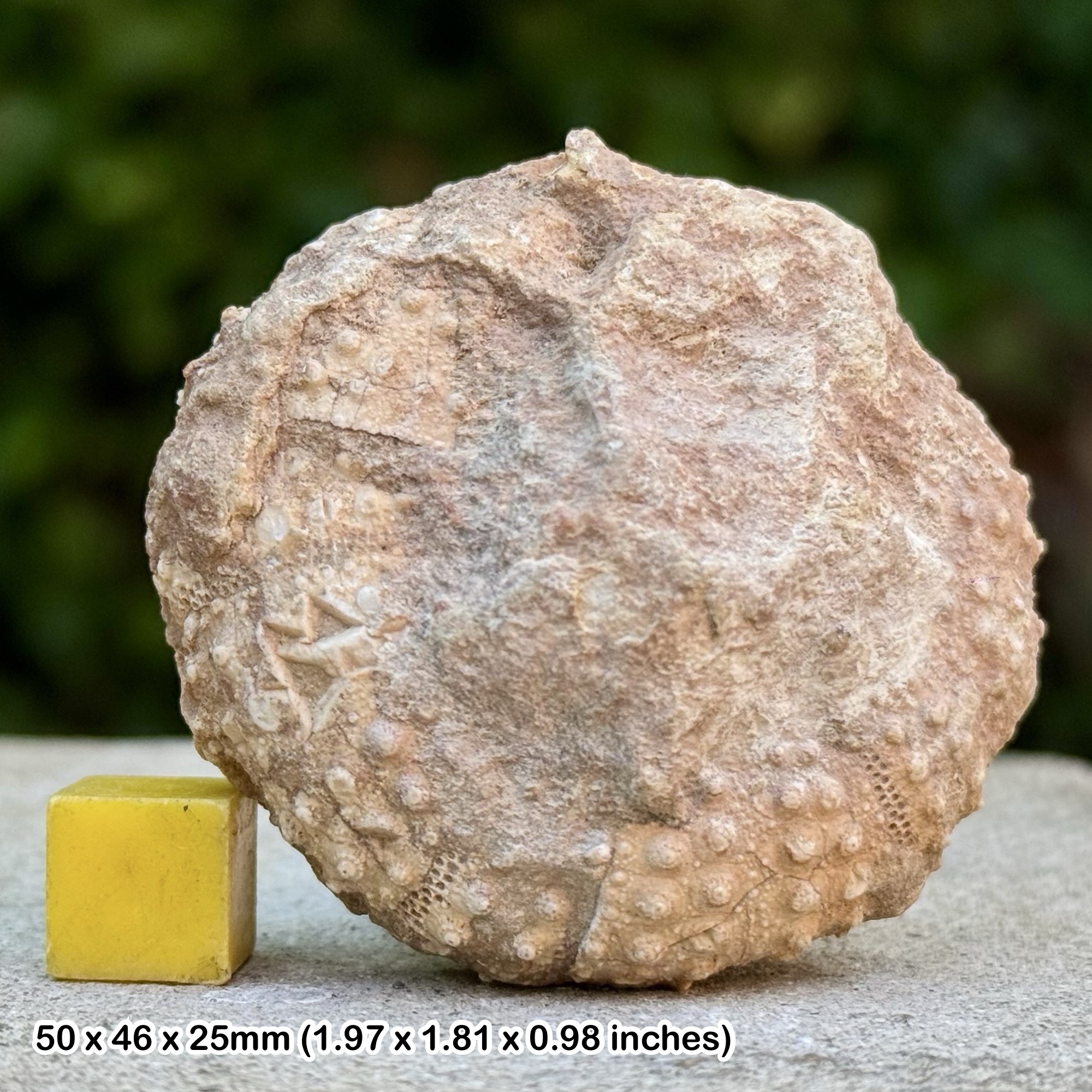
Stomechinus bigranularis Fossil Echinoid Inferior Oolite Jurassic Coast Burton Bradstock Dorset UK Authentic Collector Specimen with COA
£ 36.00
This listing is for a genuine Stomechinus bigranularis fossil echinoid,
originating from the Inferior Oolite Formation of the Middle Jurassic (approximately 174–170 million years ago). The specimen was collected on the world-famous Jurassic Coast at Burton Bradstock, Dorset, UK, a UNESCO World Heritage Site renowned for its outstanding geological record. The fossil shown in the photographs is the exact piece you will receive, pictured with a scale rule / cube = 1 cm for precise sizing. All of our fossils are 100% genuine specimens and supplied with a Certificate of Authenticity, making this a trustworthy addition to any collection. GEOLOGICAL CONTEXT: INFERIOR OOLITE, MIDDLE JURASSICThe Inferior Oolite Formation represents a series of Jurassic marine deposits, laid down in shallow, warm seas that covered much of southern England during the Middle Jurassic. These carbonate-rich sediments, dominated by oolitic limestone, are especially rich in marine fossils, including echinoids, ammonites, brachiopods, and bivalves.The Jurassic Coast at Burton Bradstock provides exceptional exposures of these formations, yielding beautifully preserved fossils that have been studied for centuries. The Inferior Oolite is particularly noted for its abundant echinoid fauna, of which Stomechinus bigranularis is one of the most distinctive. These fossils provide invaluable insights into Jurassic marine ecosystems and paleoecology. THE SPECIES: STOMECHINUS BIGRANULARISStomechinus bigranularis belongs to the phylum Echinodermata, class Echinoidea, order Stomechinidae. Like modern sea urchins, it was a benthic marine organism that lived on or just beneath the seafloor, grazing on detritus and organic material.Key features of S. bigranularis include:
• A nearly spherical to sub-oval test (shell) with a rigid calcareous structure.
• Distinctive bigranular ornamentation, from which the species takes its name, consisting of alternating large and small tubercles.
• Ambulacral areas with pores arranged in paired rows, reflecting the structure of tube feet used for locomotion and feeding.
• Interambulacral zones displaying strong, granular ornamentation, enhancing its identification.This species is widely recognised for its abundance in British Jurassic deposits and has been formally described in classic paleontological works. Its morphological detail and preservation make it both scientifically valuable and aesthetically pleasing. MORPHOLOGICAL AND SCIENTIFIC FEATURES
• Phylum: Echinodermata
• Class: Echinoidea
• Order: Stomechinidae
• Genus and Species: Stomechinus bigranularis
• Geological Stage: Middle Jurassic, Inferior Oolite (c. 174–170 Ma)
• Locality: Burton Bradstock, Dorset, UK
• Shell Traits: Granular ornamentation with alternating tubercles, paired ambulacral pores, robust calcareous test
• Scientific Importance: Index echinoid for Inferior Oolite deposits, valuable for biostratigraphy and paleoecological reconstruction COLLECTOR AND DISPLAY VALUEFossils of Stomechinus bigranularis are iconic among British Jurassic echinoids and hold significant historical importance within paleontology. Their abundance in the Inferior Oolite has made them central to the study of echinoid evolution, yet well-preserved examples remain highly desirable to collectors.The provenance from the Jurassic Coast, Dorset, greatly enhances its display and collector appeal, as this area is world-renowned for producing fossils of exceptional scientific and aesthetic quality. The inclusion of a Certificate of Authenticity ensures its provenance and authenticity.This specimen of Stomechinus bigranularis represents a genuine piece of Britain’s Jurassic heritage, perfect for fossil enthusiasts, academic study, or as a unique natural history display piece.
originating from the Inferior Oolite Formation of the Middle Jurassic (approximately 174–170 million years ago). The specimen was collected on the world-famous Jurassic Coast at Burton Bradstock, Dorset, UK, a UNESCO World Heritage Site renowned for its outstanding geological record. The fossil shown in the photographs is the exact piece you will receive, pictured with a scale rule / cube = 1 cm for precise sizing. All of our fossils are 100% genuine specimens and supplied with a Certificate of Authenticity, making this a trustworthy addition to any collection. GEOLOGICAL CONTEXT: INFERIOR OOLITE, MIDDLE JURASSICThe Inferior Oolite Formation represents a series of Jurassic marine deposits, laid down in shallow, warm seas that covered much of southern England during the Middle Jurassic. These carbonate-rich sediments, dominated by oolitic limestone, are especially rich in marine fossils, including echinoids, ammonites, brachiopods, and bivalves.The Jurassic Coast at Burton Bradstock provides exceptional exposures of these formations, yielding beautifully preserved fossils that have been studied for centuries. The Inferior Oolite is particularly noted for its abundant echinoid fauna, of which Stomechinus bigranularis is one of the most distinctive. These fossils provide invaluable insights into Jurassic marine ecosystems and paleoecology. THE SPECIES: STOMECHINUS BIGRANULARISStomechinus bigranularis belongs to the phylum Echinodermata, class Echinoidea, order Stomechinidae. Like modern sea urchins, it was a benthic marine organism that lived on or just beneath the seafloor, grazing on detritus and organic material.Key features of S. bigranularis include:
• A nearly spherical to sub-oval test (shell) with a rigid calcareous structure.
• Distinctive bigranular ornamentation, from which the species takes its name, consisting of alternating large and small tubercles.
• Ambulacral areas with pores arranged in paired rows, reflecting the structure of tube feet used for locomotion and feeding.
• Interambulacral zones displaying strong, granular ornamentation, enhancing its identification.This species is widely recognised for its abundance in British Jurassic deposits and has been formally described in classic paleontological works. Its morphological detail and preservation make it both scientifically valuable and aesthetically pleasing. MORPHOLOGICAL AND SCIENTIFIC FEATURES
• Phylum: Echinodermata
• Class: Echinoidea
• Order: Stomechinidae
• Genus and Species: Stomechinus bigranularis
• Geological Stage: Middle Jurassic, Inferior Oolite (c. 174–170 Ma)
• Locality: Burton Bradstock, Dorset, UK
• Shell Traits: Granular ornamentation with alternating tubercles, paired ambulacral pores, robust calcareous test
• Scientific Importance: Index echinoid for Inferior Oolite deposits, valuable for biostratigraphy and paleoecological reconstruction COLLECTOR AND DISPLAY VALUEFossils of Stomechinus bigranularis are iconic among British Jurassic echinoids and hold significant historical importance within paleontology. Their abundance in the Inferior Oolite has made them central to the study of echinoid evolution, yet well-preserved examples remain highly desirable to collectors.The provenance from the Jurassic Coast, Dorset, greatly enhances its display and collector appeal, as this area is world-renowned for producing fossils of exceptional scientific and aesthetic quality. The inclusion of a Certificate of Authenticity ensures its provenance and authenticity.This specimen of Stomechinus bigranularis represents a genuine piece of Britain’s Jurassic heritage, perfect for fossil enthusiasts, academic study, or as a unique natural history display piece.