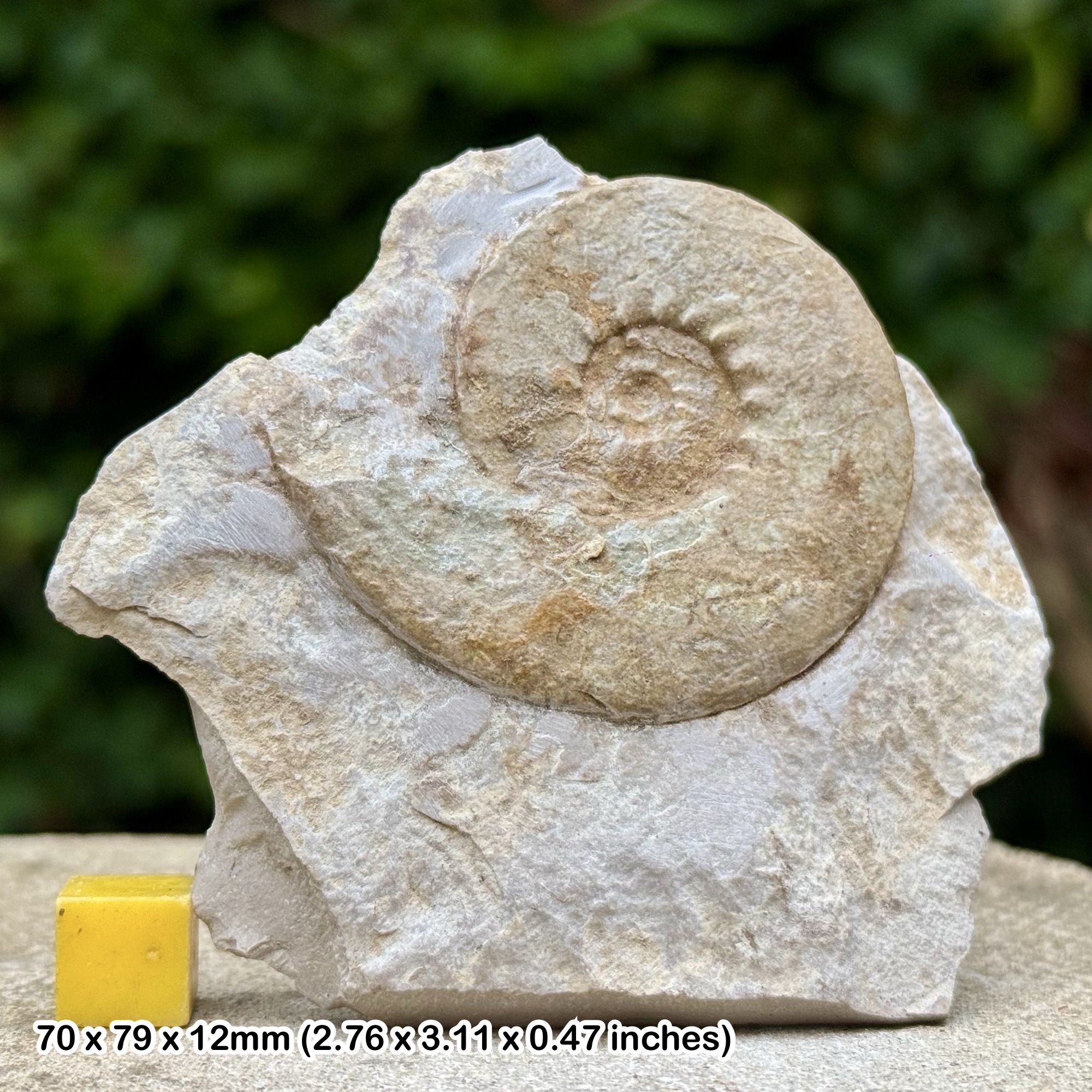
Dalmasicera Ammonite Fossil from Berriasian Cretaceous Lacisterne Boisset Gard France Authentic Specimen
£ 14.40
GEOLOGICAL CONTEXT AND PROVENANCEThis rare specimen is a genuine Dalmasicera ammonite fossil from the Berriasian
Stage of the Early Cretaceous Period, dating to approximately 145 – 139 million years ago. It comes from Lacisterne, Boisset, Gard, France, a region renowned for its fossiliferous limestone and marl deposits. These marine sediments represent some of the earliest Cretaceous formations in Europe, making ammonites from this interval especially valuable for both scientific research and collectors.The Berriasian is the very first stage of the Cretaceous, marking a significant transition in Earth’s history. Ammonites such as Dalmasicera are essential biostratigraphic markers, used to define zones within the Lower Cretaceous and to correlate marine rock layers across different regions of Europe and beyond. FOSSIL TYPE AND SPECIES INFORMATIONDalmasicera belongs to the Order Ammonitida, Superfamily Perisphinctoidea, and is closely related to families within the Neocomitidae. Ammonites of this genus are noted for their distinctive ribbing and shell morphology, which make them recognisable to specialists and highly appealing to collectors.Their importance lies not only in their visual appeal but also in their role as index fossils. Species of Dalmasicera have a relatively restricted stratigraphic range, making them excellent tools for dating and correlating Berriasian sediments. MORPHOLOGICAL FEATURES AND IDENTIFICATIONThis specimen displays the diagnostic features of Dalmasicera, including strong, well-defined ribs that cross the flanks and extend onto the venter. The shell is moderately involute, with tightly coiled whorls that form a compact and elegant shape. The ribbing pattern may show bifurcation or branching, giving the shell an ornate and decorative appearance.These morphological traits not only aid in identification but also reflect evolutionary adaptations. The ribbing strengthened the shell against the pressures of a marine environment while also providing hydrodynamic advantages. As with other ammonites, Dalmasicera had a chambered shell that allowed for buoyancy control, enabling it to live as an active nektonic predator in the open seas. DEPOSITIONAL ENVIRONMENTDuring the Berriasian, the Lacisterne–Boisset region of Gard lay beneath warm, shallow seas that were part of the vast Tethys Ocean. Sediments of limestone and marl deposited in this environment encapsulated ammonites and preserved them with exceptional clarity.The marine ecosystem of this time was rich and diverse. Ammonites like Dalmasicera hunted small molluscs, plankton, and crustaceans, while themselves being preyed upon by larger marine reptiles and predatory fish. Their abundance and evolutionary success made them a cornerstone of Early Cretaceous marine life. COLLECTOR APPEAL AND AUTHENTICITYThis Dalmasicera ammonite fossil is an outstanding specimen, prized for both its scientific significance and its natural beauty. Its strong ribbing, compact coiling, and provenance from the renowned Berriasian beds of Gard, France, make it an exceptional addition to any fossil collection.
• 100% Genuine Specimen – All fossils we supply are authentic and accompanied by a Certificate of Authenticity.
• Exact Fossil Shown – The photographs provided show the actual ammonite you will receive.
• Scale Reference – Scale rule squares / cube = 1 cm. Please see the photos for precise sizing.This carefully chosen Dalmasicera ammonite offers a tangible connection to the dawn of the Cretaceous seas. With its rarity, elegant morphology, and geological significance, it represents an extraordinary specimen for collectors, educators, and natural history enthusiasts alike.
Stage of the Early Cretaceous Period, dating to approximately 145 – 139 million years ago. It comes from Lacisterne, Boisset, Gard, France, a region renowned for its fossiliferous limestone and marl deposits. These marine sediments represent some of the earliest Cretaceous formations in Europe, making ammonites from this interval especially valuable for both scientific research and collectors.The Berriasian is the very first stage of the Cretaceous, marking a significant transition in Earth’s history. Ammonites such as Dalmasicera are essential biostratigraphic markers, used to define zones within the Lower Cretaceous and to correlate marine rock layers across different regions of Europe and beyond. FOSSIL TYPE AND SPECIES INFORMATIONDalmasicera belongs to the Order Ammonitida, Superfamily Perisphinctoidea, and is closely related to families within the Neocomitidae. Ammonites of this genus are noted for their distinctive ribbing and shell morphology, which make them recognisable to specialists and highly appealing to collectors.Their importance lies not only in their visual appeal but also in their role as index fossils. Species of Dalmasicera have a relatively restricted stratigraphic range, making them excellent tools for dating and correlating Berriasian sediments. MORPHOLOGICAL FEATURES AND IDENTIFICATIONThis specimen displays the diagnostic features of Dalmasicera, including strong, well-defined ribs that cross the flanks and extend onto the venter. The shell is moderately involute, with tightly coiled whorls that form a compact and elegant shape. The ribbing pattern may show bifurcation or branching, giving the shell an ornate and decorative appearance.These morphological traits not only aid in identification but also reflect evolutionary adaptations. The ribbing strengthened the shell against the pressures of a marine environment while also providing hydrodynamic advantages. As with other ammonites, Dalmasicera had a chambered shell that allowed for buoyancy control, enabling it to live as an active nektonic predator in the open seas. DEPOSITIONAL ENVIRONMENTDuring the Berriasian, the Lacisterne–Boisset region of Gard lay beneath warm, shallow seas that were part of the vast Tethys Ocean. Sediments of limestone and marl deposited in this environment encapsulated ammonites and preserved them with exceptional clarity.The marine ecosystem of this time was rich and diverse. Ammonites like Dalmasicera hunted small molluscs, plankton, and crustaceans, while themselves being preyed upon by larger marine reptiles and predatory fish. Their abundance and evolutionary success made them a cornerstone of Early Cretaceous marine life. COLLECTOR APPEAL AND AUTHENTICITYThis Dalmasicera ammonite fossil is an outstanding specimen, prized for both its scientific significance and its natural beauty. Its strong ribbing, compact coiling, and provenance from the renowned Berriasian beds of Gard, France, make it an exceptional addition to any fossil collection.
• 100% Genuine Specimen – All fossils we supply are authentic and accompanied by a Certificate of Authenticity.
• Exact Fossil Shown – The photographs provided show the actual ammonite you will receive.
• Scale Reference – Scale rule squares / cube = 1 cm. Please see the photos for precise sizing.This carefully chosen Dalmasicera ammonite offers a tangible connection to the dawn of the Cretaceous seas. With its rarity, elegant morphology, and geological significance, it represents an extraordinary specimen for collectors, educators, and natural history enthusiasts alike.
Other Products