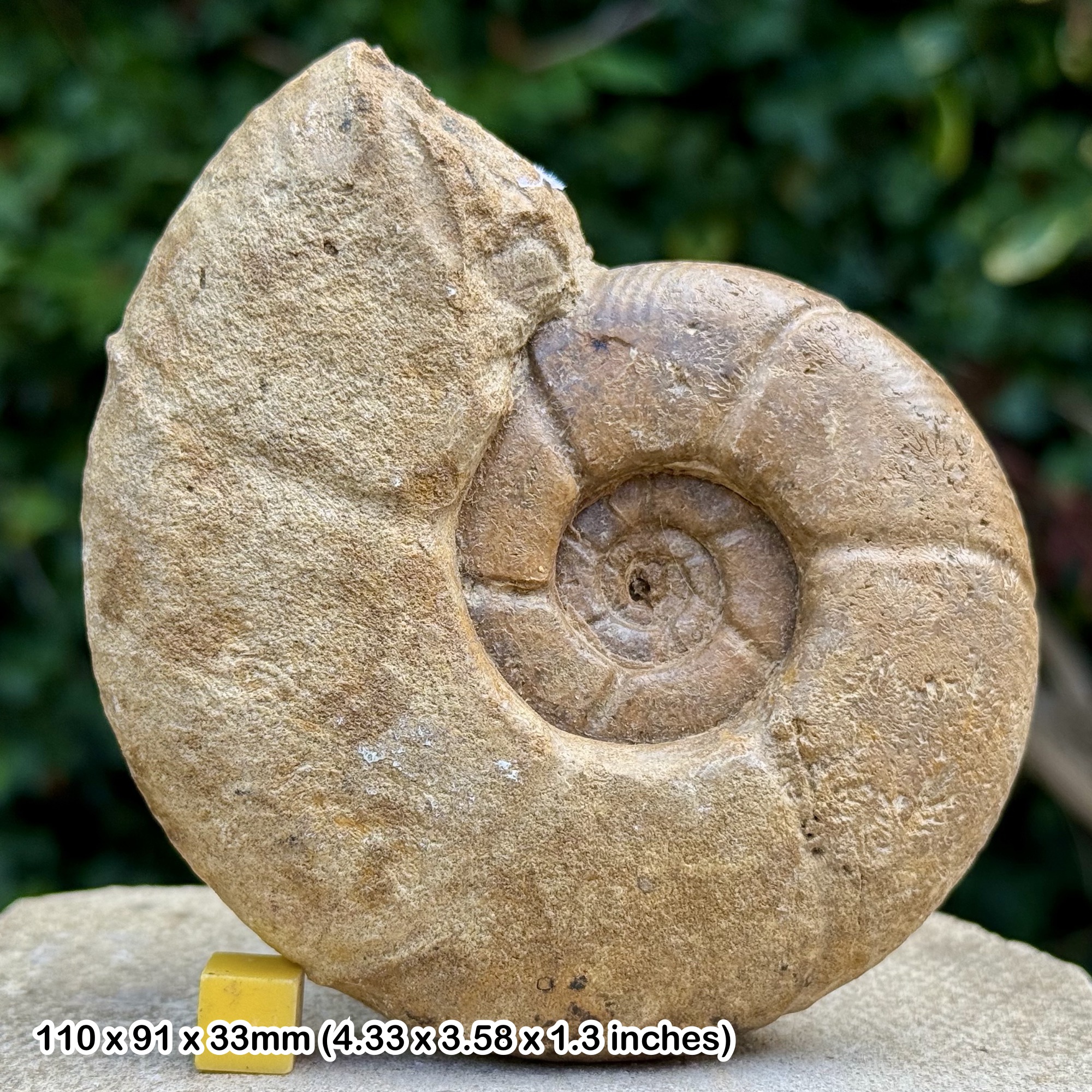
4.5" Hauericeras gardeni Ammonite Fossil Rare Campanian Cretaceous Madagascar COA
£ 240.00
HAUERICERAS GARDENI AMMONITE FOSSILThis listing features a 4.5-inch Hauericeras gardeni Ammonite Fossil,
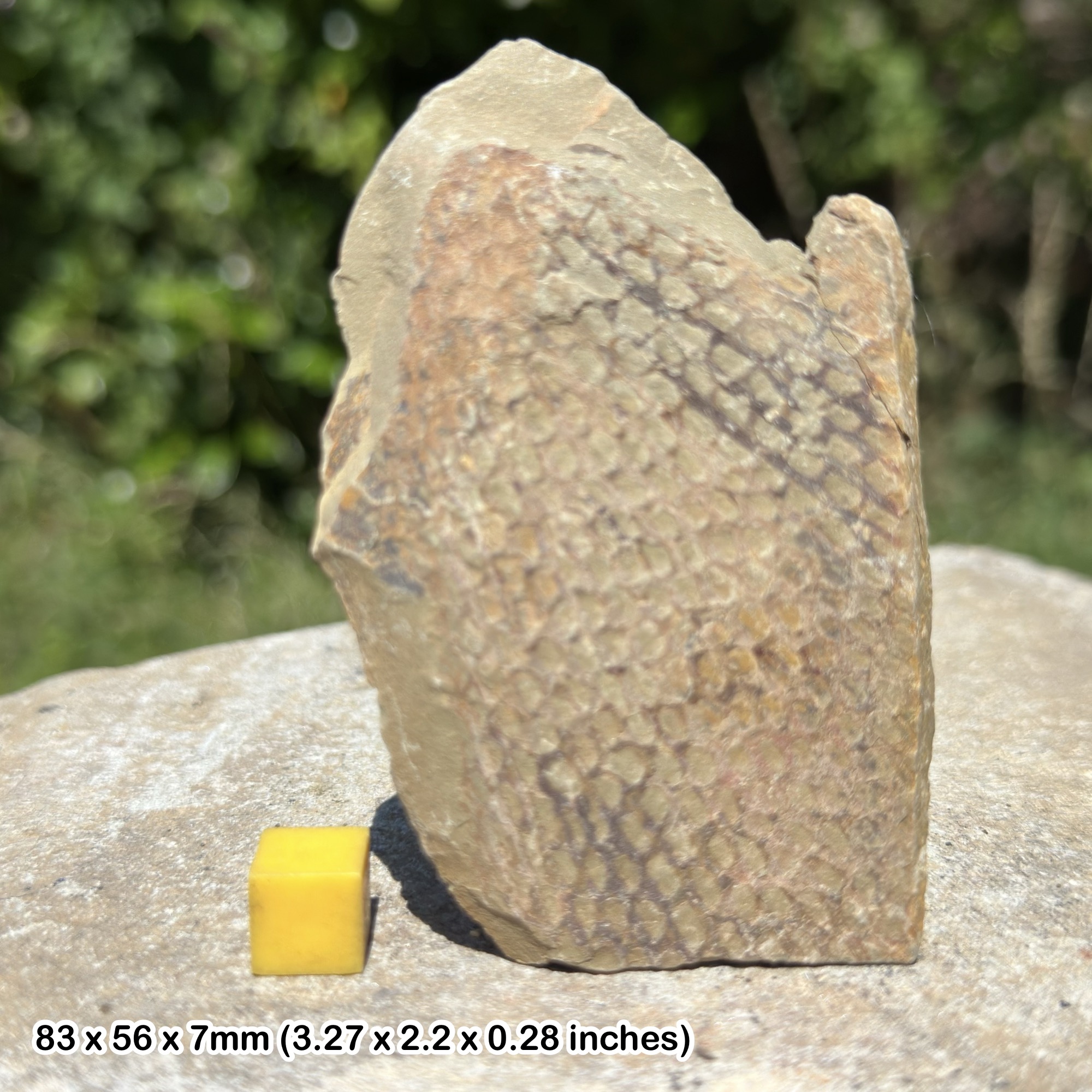
originating from the Campanian stage of the Late Cretaceous, collected in Madagascar. This ammonite dates back approximately 83–72 million years ago, during a time when Madagascar was part of a thriving tropical marine environment within the southern hemisphere. The exact fossil shown in the photographs is the one you will receive, with a 1 cm scale cube provided for accurate measurement. Every specimen is 100% genuine and accompanied by a Certificate of Authenticity. GEOLOGICAL CONTEXT – CAMPANIAN OF MADAGASCARThe Campanian stage is one of the key subdivisions of the Late Cretaceous, marked by widespread shallow seas and high biodiversity. Madagascar’s fossil beds are particularly famous for their rich assemblages of ammonites, reflecting a once-thriving marine ecosystem on the margins of the ancient Tethys Ocean. Sediments from this time are typically limestones and marls deposited in warm, shallow marine basins, ideal for preserving the intricate shell structures of ammonites.Ammonites from Madagascar, especially those of the genus Hauericeras, are sought after for their exceptional preservation and aesthetic appeal. They often exhibit fine suture patterns, robust shells, and distinctive ribbing that capture the complexity of these ancient cephalopods. SPECIES OVERVIEW – HAUERICERAS GARDENIThis specimen belongs to the genus Hauericeras, order Ammonitida, superfamily Acanthoceratoidea, and family Collignoniceratidae. The species Hauericeras gardeni is characterised by its moderately involute shell, compressed whorls, and distinctive ribbing that sweeps gracefully across the flanks.Its shell morphology is both diagnostic and visually striking, with ribs that may become stronger towards the venter, enhancing the symmetry and balance of the fossil. The suture lines are often highly complex and detailed, reflecting evolutionary refinements in buoyancy and structural reinforcement. These features make Hauericeras gardeni a scientifically significant and visually appealing fossil. PALEONTOLOGICAL IMPORTANCEHauericeras gardeni is an important ammonite for biostratigraphy, as its stratigraphic range helps paleontologists correlate Campanian deposits worldwide. Its presence provides insight into the distribution of ammonite faunas across the southern continents during the Late Cretaceous, contributing to our understanding of paleobiogeography.The evolutionary adaptations of Hauericeras—such as its streamlined whorl cross-section and reinforced ribbing—suggest a life adapted for efficient movement in the water column. These traits highlight the ecological roles ammonites played in Cretaceous seas, both as predators and as prey for larger marine reptiles and fish. COLLECTOR’S AND DISPLAY VALUEThis 4.5" Hauericeras gardeni ammonite fossil is an exceptional specimen for collectors of Cretaceous ammonites or Madagascan fossils. Its size, preservation, and provenance make it a particularly desirable addition to both private and museum-quality collections.Beyond scientific value, this ammonite’s intricate ribbing and natural symmetry make it a stunning display piece. Whether showcased in a fossil cabinet or as a focal point in a collection, it represents both natural history and timeless beauty. GUARANTEE OF AUTHENTICITY
• Genuine Hauericeras gardeni ammonite fossil from Madagascar
• Supplied with a Certificate of Authenticity
• Exact specimen shown in the photographs will be sentThis is a rare opportunity to acquire a large, well-preserved Hauericeras gardeni Ammonite Fossil from the Campanian stage of the Cretaceous, Madagascar—a scientifically important and visually striking piece of Earth’s history.
originating from the Campanian stage of the Late Cretaceous, collected in Madagascar. This ammonite dates back approximately 83–72 million years ago, during a time when Madagascar was part of a thriving tropical marine environment within the southern hemisphere. The exact fossil shown in the photographs is the one you will receive, with a 1 cm scale cube provided for accurate measurement. Every specimen is 100% genuine and accompanied by a Certificate of Authenticity. GEOLOGICAL CONTEXT – CAMPANIAN OF MADAGASCARThe Campanian stage is one of the key subdivisions of the Late Cretaceous, marked by widespread shallow seas and high biodiversity. Madagascar’s fossil beds are particularly famous for their rich assemblages of ammonites, reflecting a once-thriving marine ecosystem on the margins of the ancient Tethys Ocean. Sediments from this time are typically limestones and marls deposited in warm, shallow marine basins, ideal for preserving the intricate shell structures of ammonites.Ammonites from Madagascar, especially those of the genus Hauericeras, are sought after for their exceptional preservation and aesthetic appeal. They often exhibit fine suture patterns, robust shells, and distinctive ribbing that capture the complexity of these ancient cephalopods. SPECIES OVERVIEW – HAUERICERAS GARDENIThis specimen belongs to the genus Hauericeras, order Ammonitida, superfamily Acanthoceratoidea, and family Collignoniceratidae. The species Hauericeras gardeni is characterised by its moderately involute shell, compressed whorls, and distinctive ribbing that sweeps gracefully across the flanks.Its shell morphology is both diagnostic and visually striking, with ribs that may become stronger towards the venter, enhancing the symmetry and balance of the fossil. The suture lines are often highly complex and detailed, reflecting evolutionary refinements in buoyancy and structural reinforcement. These features make Hauericeras gardeni a scientifically significant and visually appealing fossil. PALEONTOLOGICAL IMPORTANCEHauericeras gardeni is an important ammonite for biostratigraphy, as its stratigraphic range helps paleontologists correlate Campanian deposits worldwide. Its presence provides insight into the distribution of ammonite faunas across the southern continents during the Late Cretaceous, contributing to our understanding of paleobiogeography.The evolutionary adaptations of Hauericeras—such as its streamlined whorl cross-section and reinforced ribbing—suggest a life adapted for efficient movement in the water column. These traits highlight the ecological roles ammonites played in Cretaceous seas, both as predators and as prey for larger marine reptiles and fish. COLLECTOR’S AND DISPLAY VALUEThis 4.5" Hauericeras gardeni ammonite fossil is an exceptional specimen for collectors of Cretaceous ammonites or Madagascan fossils. Its size, preservation, and provenance make it a particularly desirable addition to both private and museum-quality collections.Beyond scientific value, this ammonite’s intricate ribbing and natural symmetry make it a stunning display piece. Whether showcased in a fossil cabinet or as a focal point in a collection, it represents both natural history and timeless beauty. GUARANTEE OF AUTHENTICITY
• Genuine Hauericeras gardeni ammonite fossil from Madagascar
• Supplied with a Certificate of Authenticity
• Exact specimen shown in the photographs will be sentThis is a rare opportunity to acquire a large, well-preserved Hauericeras gardeni Ammonite Fossil from the Campanian stage of the Cretaceous, Madagascar—a scientifically important and visually striking piece of Earth’s history.