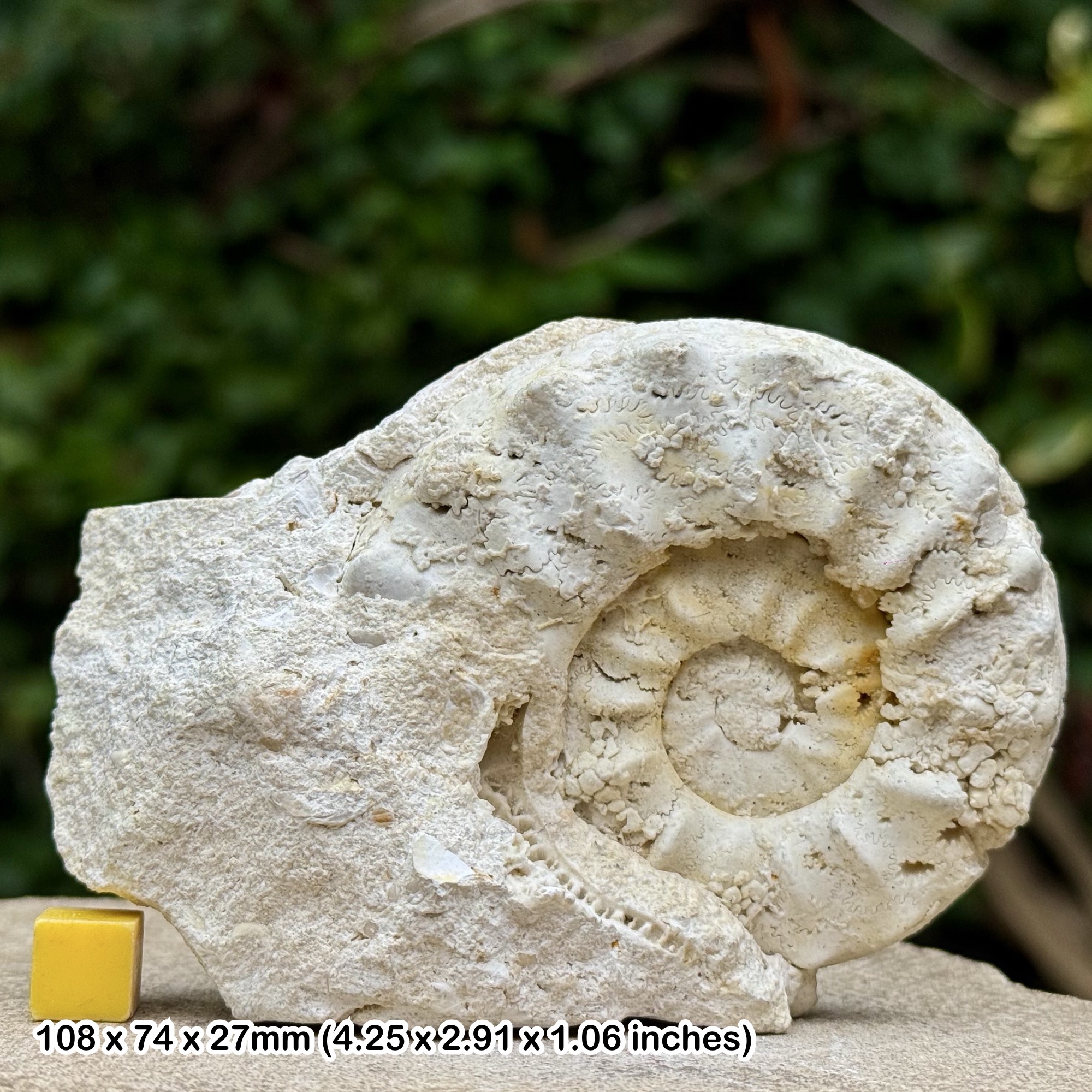
Gauthiericeras margae Fossil Ammonite Middle Coniacian Cretaceous Grizac France with Certificate of Authenticity
£ 24.00
AUTHENTIC GAUTHIERICERAS MARGAE FOSSIL AMMONITEOffered here is a genuine Gauthiericeras margae fossil ammonite, dating from the
Middle Coniacian Stage of the Late Cretaceous Period, approximately 89–87 million years ago. This beautiful specimen was recovered from Grizac, France, a locality known for producing scientifically significant ammonites of exceptional preservation. Each fossil we offer is carefully selected, photographed, and supplied with a Certificate of Authenticity, ensuring its status as a 100% genuine specimen. A 1 cm scale rule and cube is shown in the photos for accurate size reference. GEOLOGICAL SETTINGDuring the Middle Coniacian, Europe was covered by extensive warm epicontinental seas, forming an environment ideal for ammonite diversification. The deposits around Grizac, France, consist primarily of marly limestones and calcareous shales laid down in these marine environments. Ammonites such as Gauthiericeras thrived in these nutrient-rich waters, and their remains became preserved within these sediments, now forming key fossiliferous layers that aid in biostratigraphic correlation across the Late Cretaceous.The Coniacian stage itself plays an important role in global stratigraphy, positioned between the Santonian and Turonian stages, and is characterised by the evolutionary expansion of distinct ammonite lineages like Gauthiericeras. SCIENTIFIC CLASSIFICATION
• Genus: Gauthiericeras
• Species: Gauthiericeras margae
• Order: Ammonitida
• Superfamily: Acanthocerataceae
• Family: Collignoniceratidae
• Geological Stage: Middle Coniacian, Late Cretaceous
• Provenance: Grizac, FranceThis ammonite represents an important reference point within the ammonite biozones of the Coniacian, with Gauthiericeras margae frequently cited in stratigraphic frameworks for this part of the Cretaceous. MORPHOLOGICAL FEATURESGauthiericeras margae displays several distinctive and scientifically important features:
• Thick, robust whorls with moderate involution.
• Prominent ribbing and tuberculation, often extending across the flanks and venter.
• Strongly ornamented shell, characteristic of the Collignoniceratidae family.
• A suture line of intricate complexity, reflecting evolutionary advancement in Late Cretaceous ammonites.
• Large, well-developed body chambers that suggest adaptation to open marine conditions.These features make the fossil both a valuable research specimen and an impressive display piece for collectors. IMPORTANCE IN SCIENCE AND COLLECTINGGauthiericeras margae is more than just a striking fossil—it serves as an essential index fossil for correlating Coniacian strata across Europe and North Africa. Its clearly defined morphological traits allow paleontologists to place rock layers with precision, contributing to our understanding of the Cretaceous marine ecosystems and the evolutionary pathways of ammonites.For collectors, this ammonite represents both rarity and beauty. French ammonite localities such as Grizac are highly regarded for their preservation quality and their role in shaping scientific knowledge of the Coniacian stage. This makes specimens from this region both scientifically significant and highly desirable. DISPLAY AND EDUCATIONAL VALUEThis Gauthiericeras margae fossil ammonite from Grizac, France makes an exceptional addition to:
• Private collections, offering rarity and historical significance.
• Educational resources, serving as an excellent teaching tool for paleontology and geology.
• Museum-quality displays, showcasing the natural artistry of ammonite shell morphology.
• Decorative displays, where it brings an authentic prehistoric presence into homes, offices, or study spaces.With its bold ornamentation, scientific importance, and provenance from one of France’s most renowned fossil localities, this specimen captures the essence of Late Cretaceous marine life and offers a unique opportunity to own a genuine piece of deep geological history.
Middle Coniacian Stage of the Late Cretaceous Period, approximately 89–87 million years ago. This beautiful specimen was recovered from Grizac, France, a locality known for producing scientifically significant ammonites of exceptional preservation. Each fossil we offer is carefully selected, photographed, and supplied with a Certificate of Authenticity, ensuring its status as a 100% genuine specimen. A 1 cm scale rule and cube is shown in the photos for accurate size reference. GEOLOGICAL SETTINGDuring the Middle Coniacian, Europe was covered by extensive warm epicontinental seas, forming an environment ideal for ammonite diversification. The deposits around Grizac, France, consist primarily of marly limestones and calcareous shales laid down in these marine environments. Ammonites such as Gauthiericeras thrived in these nutrient-rich waters, and their remains became preserved within these sediments, now forming key fossiliferous layers that aid in biostratigraphic correlation across the Late Cretaceous.The Coniacian stage itself plays an important role in global stratigraphy, positioned between the Santonian and Turonian stages, and is characterised by the evolutionary expansion of distinct ammonite lineages like Gauthiericeras. SCIENTIFIC CLASSIFICATION
• Genus: Gauthiericeras
• Species: Gauthiericeras margae
• Order: Ammonitida
• Superfamily: Acanthocerataceae
• Family: Collignoniceratidae
• Geological Stage: Middle Coniacian, Late Cretaceous
• Provenance: Grizac, FranceThis ammonite represents an important reference point within the ammonite biozones of the Coniacian, with Gauthiericeras margae frequently cited in stratigraphic frameworks for this part of the Cretaceous. MORPHOLOGICAL FEATURESGauthiericeras margae displays several distinctive and scientifically important features:
• Thick, robust whorls with moderate involution.
• Prominent ribbing and tuberculation, often extending across the flanks and venter.
• Strongly ornamented shell, characteristic of the Collignoniceratidae family.
• A suture line of intricate complexity, reflecting evolutionary advancement in Late Cretaceous ammonites.
• Large, well-developed body chambers that suggest adaptation to open marine conditions.These features make the fossil both a valuable research specimen and an impressive display piece for collectors. IMPORTANCE IN SCIENCE AND COLLECTINGGauthiericeras margae is more than just a striking fossil—it serves as an essential index fossil for correlating Coniacian strata across Europe and North Africa. Its clearly defined morphological traits allow paleontologists to place rock layers with precision, contributing to our understanding of the Cretaceous marine ecosystems and the evolutionary pathways of ammonites.For collectors, this ammonite represents both rarity and beauty. French ammonite localities such as Grizac are highly regarded for their preservation quality and their role in shaping scientific knowledge of the Coniacian stage. This makes specimens from this region both scientifically significant and highly desirable. DISPLAY AND EDUCATIONAL VALUEThis Gauthiericeras margae fossil ammonite from Grizac, France makes an exceptional addition to:
• Private collections, offering rarity and historical significance.
• Educational resources, serving as an excellent teaching tool for paleontology and geology.
• Museum-quality displays, showcasing the natural artistry of ammonite shell morphology.
• Decorative displays, where it brings an authentic prehistoric presence into homes, offices, or study spaces.With its bold ornamentation, scientific importance, and provenance from one of France’s most renowned fossil localities, this specimen captures the essence of Late Cretaceous marine life and offers a unique opportunity to own a genuine piece of deep geological history.
Other Products