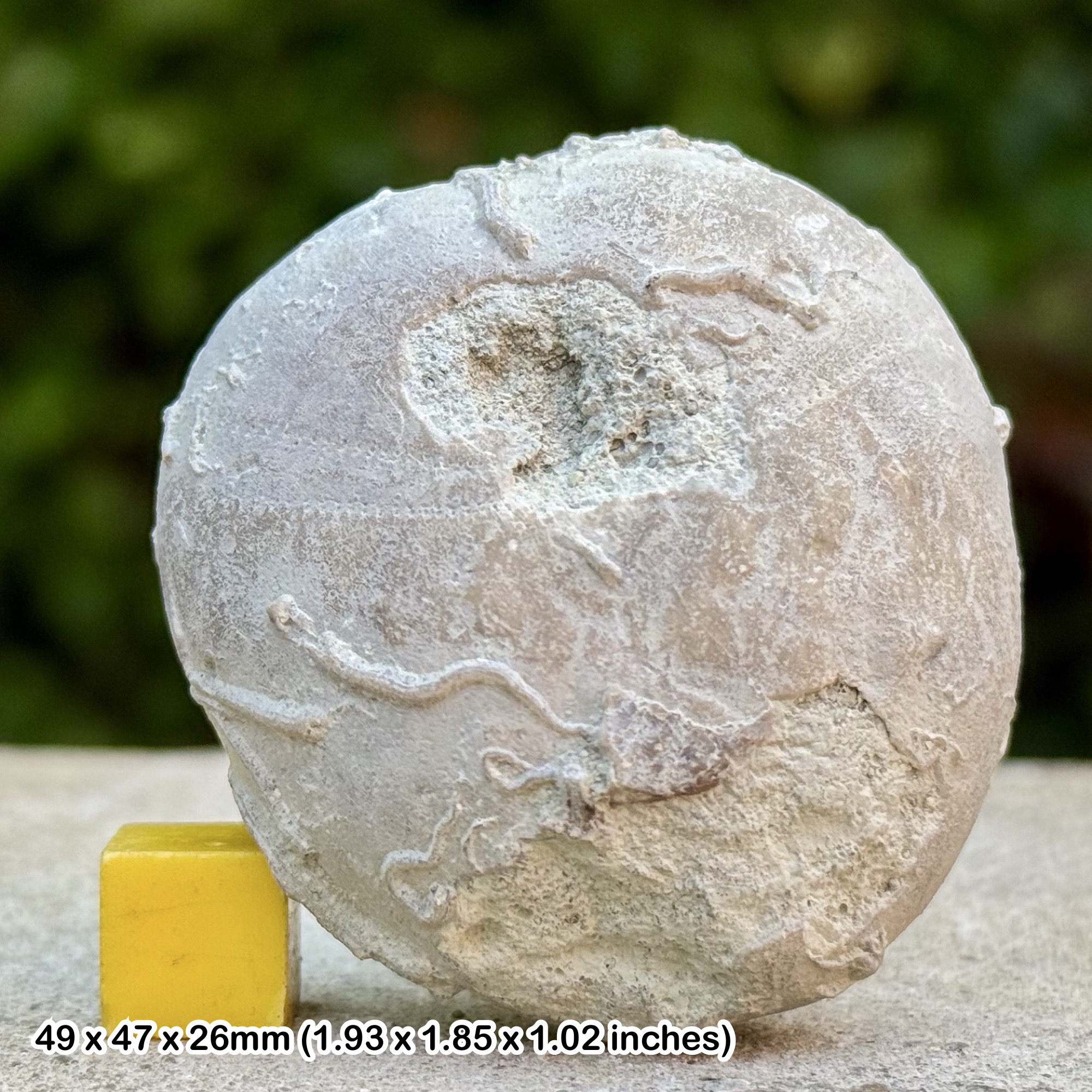
Holaster Fossil Echinoid Cretaceous Upper Greensand Ventnor Isle of Wight England Authentic Specimen with Certificate of Authenticity
£ 24.00
This listing is for a Holaster fossil echinoid from the Upper Greensand
Formation, Cretaceous period, discovered at Ventnor, Isle of Wight, England. Holaster echinoids are among the most iconic fossils from southern England, representing irregular sea urchins that once thrived in the shallow seas covering the region during the mid-Cretaceous. This specimen is a carefully chosen example, photographed clearly to show the exact fossil you will receive. A 1 cm scale cube is included in the images for accurate sizing reference.As with all of our items, this is a 100% genuine fossil and is accompanied by a Certificate of Authenticity for complete assurance of its provenance. GEOLOGICAL CONTEXT: UPPER GREENSAND OF THE ISLE OF WIGHTThe Upper Greensand Formation was deposited during the Cretaceous period, approximately 113–100 million years ago. This formation is rich in glauconitic sands, marls, and calcareous layers, recording the transition between nearshore and deeper marine environments. The Isle of Wight, particularly the Ventnor area, is one of the most celebrated fossil localities in Britain, known for its outstanding preservation of marine life from the Mesozoic seas.Holaster echinoids are commonly associated with these deposits, preserved within the glauconitic sandstone matrix that captures remarkable detail of their test structure. These fossils provide an invaluable insight into Cretaceous marine ecosystems. SPECIES OVERVIEW: HOLASTER
• Phylum: Echinodermata
• Class: Echinoidea
• Order: Holasteroida
• Family: Holasteridae
• Genus: HolasterMembers of this genus are irregular echinoids, adapted for life on or within soft sediments. Unlike regular echinoids such as sea urchins with radial symmetry, Holaster species evolved bilateral symmetry, an adaptation for burrowing and feeding on organic material within the sediment. MORPHOLOGICAL FEATURESThis fossil demonstrates several of the typical features of Holaster echinoids:
• Heart-shaped test with an elongate form, gently domed above and flattened below.
• Bilateral symmetry, reflecting its adaptation to a semi-infaunal lifestyle.
• Petaloid ambulacra that form a distinctive star-like arrangement, linked to respiration.
• Periproct (anal opening) positioned towards the rear margin, typical of irregular echinoids.These features illustrate the evolutionary adaptations of echinoids as they diversified into new ecological niches during the Cretaceous. DEPOSITIONAL ENVIRONMENTThe Upper Greensand sea was a warm, shallow marine environment where glauconitic sands accumulated. This habitat supported a variety of marine organisms including ammonites, bivalves, brachiopods, crustaceans, and echinoids like Holaster. The sediment in which these echinoids were buried helped preserve fine details of their tests, creating scientifically valuable and collectible specimens. COLLECTOR AND SCIENTIFIC VALUEHolaster fossils are highly sought after by collectors due to their distinctive shape, good preservation, and their connection to one of Britain’s most famous fossil localities. For researchers and enthusiasts, they serve as important examples of the evolutionary pathways of echinoids, demonstrating how these organisms adapted to shifting Cretaceous marine environments.This specimen from Ventnor is not only scientifically significant but also a visually appealing piece for display, showing clear morphology and preserved features characteristic of Holaster. PROVENANCE AND AUTHENTICITY
• Locality: Ventnor, Isle of Wight, England
• Formation: Upper Greensand
• Period: CretaceousThis fossil is exactly as pictured and comes with a Certificate of Authenticity. Carefully chosen for quality and clarity, it represents an outstanding example of a classic British fossil echinoid.This Holaster fossil echinoid from the Upper Greensand of Ventnor is both a collectible specimen and a piece of natural history, perfect for enthusiasts, educators, or display in any fossil collection.
Formation, Cretaceous period, discovered at Ventnor, Isle of Wight, England. Holaster echinoids are among the most iconic fossils from southern England, representing irregular sea urchins that once thrived in the shallow seas covering the region during the mid-Cretaceous. This specimen is a carefully chosen example, photographed clearly to show the exact fossil you will receive. A 1 cm scale cube is included in the images for accurate sizing reference.As with all of our items, this is a 100% genuine fossil and is accompanied by a Certificate of Authenticity for complete assurance of its provenance. GEOLOGICAL CONTEXT: UPPER GREENSAND OF THE ISLE OF WIGHTThe Upper Greensand Formation was deposited during the Cretaceous period, approximately 113–100 million years ago. This formation is rich in glauconitic sands, marls, and calcareous layers, recording the transition between nearshore and deeper marine environments. The Isle of Wight, particularly the Ventnor area, is one of the most celebrated fossil localities in Britain, known for its outstanding preservation of marine life from the Mesozoic seas.Holaster echinoids are commonly associated with these deposits, preserved within the glauconitic sandstone matrix that captures remarkable detail of their test structure. These fossils provide an invaluable insight into Cretaceous marine ecosystems. SPECIES OVERVIEW: HOLASTER
• Phylum: Echinodermata
• Class: Echinoidea
• Order: Holasteroida
• Family: Holasteridae
• Genus: HolasterMembers of this genus are irregular echinoids, adapted for life on or within soft sediments. Unlike regular echinoids such as sea urchins with radial symmetry, Holaster species evolved bilateral symmetry, an adaptation for burrowing and feeding on organic material within the sediment. MORPHOLOGICAL FEATURESThis fossil demonstrates several of the typical features of Holaster echinoids:
• Heart-shaped test with an elongate form, gently domed above and flattened below.
• Bilateral symmetry, reflecting its adaptation to a semi-infaunal lifestyle.
• Petaloid ambulacra that form a distinctive star-like arrangement, linked to respiration.
• Periproct (anal opening) positioned towards the rear margin, typical of irregular echinoids.These features illustrate the evolutionary adaptations of echinoids as they diversified into new ecological niches during the Cretaceous. DEPOSITIONAL ENVIRONMENTThe Upper Greensand sea was a warm, shallow marine environment where glauconitic sands accumulated. This habitat supported a variety of marine organisms including ammonites, bivalves, brachiopods, crustaceans, and echinoids like Holaster. The sediment in which these echinoids were buried helped preserve fine details of their tests, creating scientifically valuable and collectible specimens. COLLECTOR AND SCIENTIFIC VALUEHolaster fossils are highly sought after by collectors due to their distinctive shape, good preservation, and their connection to one of Britain’s most famous fossil localities. For researchers and enthusiasts, they serve as important examples of the evolutionary pathways of echinoids, demonstrating how these organisms adapted to shifting Cretaceous marine environments.This specimen from Ventnor is not only scientifically significant but also a visually appealing piece for display, showing clear morphology and preserved features characteristic of Holaster. PROVENANCE AND AUTHENTICITY
• Locality: Ventnor, Isle of Wight, England
• Formation: Upper Greensand
• Period: CretaceousThis fossil is exactly as pictured and comes with a Certificate of Authenticity. Carefully chosen for quality and clarity, it represents an outstanding example of a classic British fossil echinoid.This Holaster fossil echinoid from the Upper Greensand of Ventnor is both a collectible specimen and a piece of natural history, perfect for enthusiasts, educators, or display in any fossil collection.
Other Products