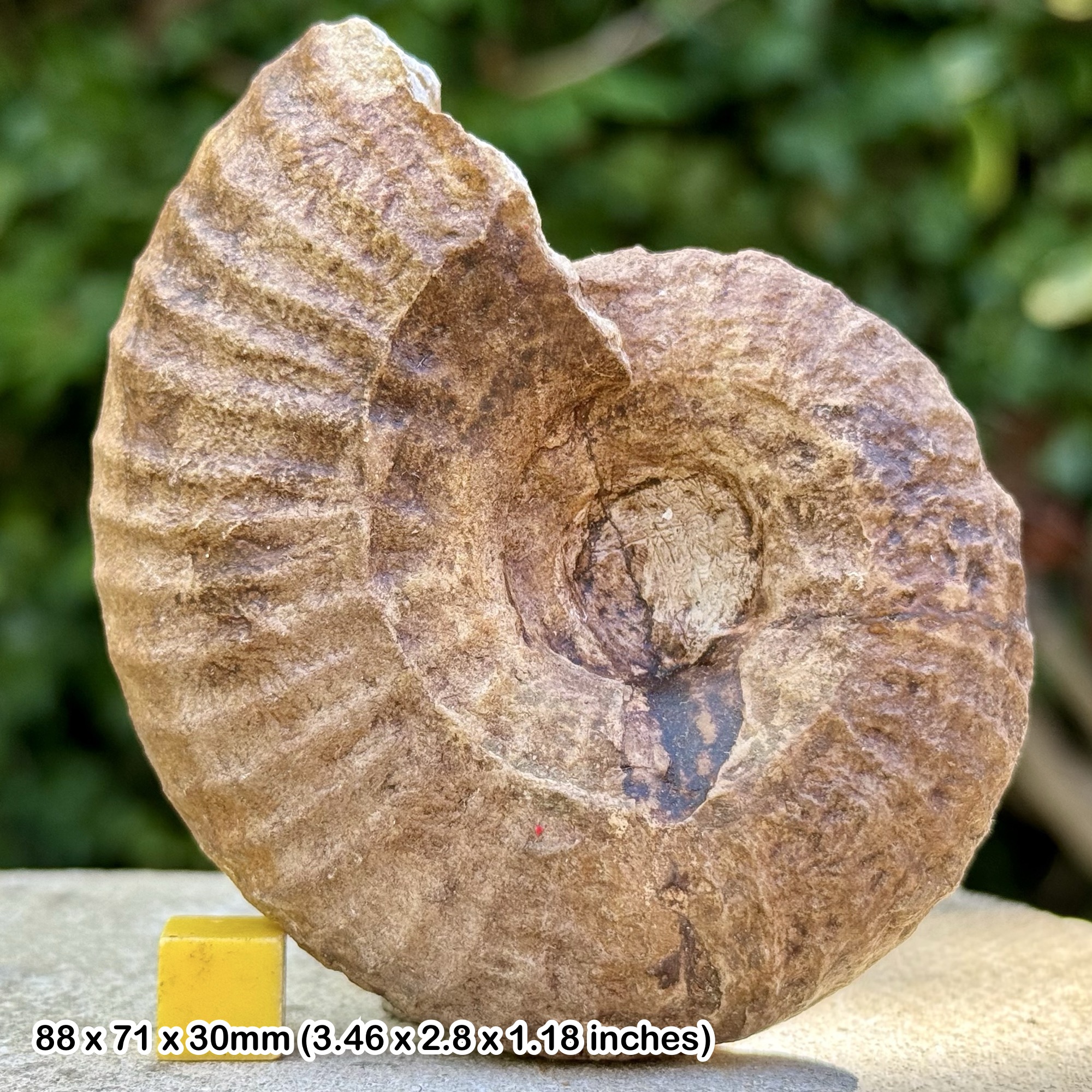
RARE Pachydiscus neubergicus raricostatus Ammonite Fossil Campanian Cretaceous Poland COA
£ 36.00
PACHYDISCUS NEUBERGICUS RARICOSTATUS AMMONITE FOSSILThis is a rare Pachydiscus neubergicus raricostatus ammonite fossil, originating
from the Campanian stage of the Late Cretaceous and discovered in Bursco, Poland. Dated to approximately 83–72 million years ago, this fossil is a genuine relic of Earth’s deep past. The fossil is shown exactly in the photographs provided, with a 1 cm scale cube for accurate sizing. Every specimen offered is 100% authentic and supplied with a Certificate of Authenticity. GEOLOGICAL SETTING – CAMPANIAN OF POLANDThe Campanian stage is a subdivision of the Late Cretaceous, a period characterised by warm shallow seas, high sea levels, and flourishing marine ecosystems. Poland, during this time, was covered by the epicontinental seas of the Tethyan realm. The Bursco region is particularly significant for its well-preserved ammonite faunas, providing critical insights into Late Cretaceous marine biodiversity and paleoenvironments.Sediments from this area are typically marly limestones and fine-grained marine deposits, which created ideal conditions for the fossilisation of ammonites. The preservation of Pachydiscus neubergicus raricostatus in these deposits reflects not only the richness of the environment but also its geological importance as part of global Campanian stratigraphy. SPECIES OVERVIEW – PACHYDISCUS NEUBERGICUS RARICOSTATUSThe genus Pachydiscus belongs to the order Ammonitida, superfamily Desmoceratoidea, and family Pachydiscidae. Within this genus, Pachydiscus neubergicus raricostatus is a rare and scientifically valuable variety.These ammonites are characterised by:
• Large, robust shells with moderately involute coiling
• Strong but widely spaced ribs (reflected in the name raricostatus)
• Complex suture patterns typical of Late Cretaceous ammonites
• Broad, rounded whorls with ribbing that strengthens toward the venterThe combination of size, ribbing, and suture complexity makes this species highly diagnostic and attractive for collectors. SCIENTIFIC AND PALEONTOLOGICAL IMPORTANCEPachydiscus neubergicus is considered an important index fossil for the Campanian stage, used in correlating marine sediments across Europe. Its restricted stratigraphic distribution makes it invaluable for establishing relative ages of Cretaceous rock layers.The raricostatus form, with its distinctive ribbing pattern, adds another layer of significance, representing morphological variation within the species. This provides paleontologists with insights into evolutionary trends, paleoecology, and environmental adaptations of ammonites during the Late Cretaceous. COLLECTOR’S AND DISPLAY VALUEThis specimen of Pachydiscus neubergicus raricostatus is not only scientifically valuable but also a striking fossil for display. The rarity of this taxon, especially from Bursco, Poland, makes it highly sought after by both advanced collectors and institutions. Its clear ribbing, shell structure, and provenance from a historically important European locality ensure its appeal as a centrepiece specimen.For educational use, it provides an outstanding example of Cretaceous ammonite diversity and morphology, offering a direct connection to marine life from nearly 80 million years ago. GUARANTEE OF AUTHENTICITY
• 100% genuine Pachydiscus neubergicus raricostatus ammonite fossil
• From the Campanian stage of the Cretaceous, Bursco, Poland
• Accompanied by a Certificate of Authenticity
• The exact fossil photographed is the one suppliedThis rare Pachydiscus neubergicus raricostatus ammonite fossil represents a significant and beautiful piece of natural history, combining scientific importance with aesthetic appeal. It is a superb acquisition for collectors of rare Cretaceous ammonites and fossils of Europe.
from the Campanian stage of the Late Cretaceous and discovered in Bursco, Poland. Dated to approximately 83–72 million years ago, this fossil is a genuine relic of Earth’s deep past. The fossil is shown exactly in the photographs provided, with a 1 cm scale cube for accurate sizing. Every specimen offered is 100% authentic and supplied with a Certificate of Authenticity. GEOLOGICAL SETTING – CAMPANIAN OF POLANDThe Campanian stage is a subdivision of the Late Cretaceous, a period characterised by warm shallow seas, high sea levels, and flourishing marine ecosystems. Poland, during this time, was covered by the epicontinental seas of the Tethyan realm. The Bursco region is particularly significant for its well-preserved ammonite faunas, providing critical insights into Late Cretaceous marine biodiversity and paleoenvironments.Sediments from this area are typically marly limestones and fine-grained marine deposits, which created ideal conditions for the fossilisation of ammonites. The preservation of Pachydiscus neubergicus raricostatus in these deposits reflects not only the richness of the environment but also its geological importance as part of global Campanian stratigraphy. SPECIES OVERVIEW – PACHYDISCUS NEUBERGICUS RARICOSTATUSThe genus Pachydiscus belongs to the order Ammonitida, superfamily Desmoceratoidea, and family Pachydiscidae. Within this genus, Pachydiscus neubergicus raricostatus is a rare and scientifically valuable variety.These ammonites are characterised by:
• Large, robust shells with moderately involute coiling
• Strong but widely spaced ribs (reflected in the name raricostatus)
• Complex suture patterns typical of Late Cretaceous ammonites
• Broad, rounded whorls with ribbing that strengthens toward the venterThe combination of size, ribbing, and suture complexity makes this species highly diagnostic and attractive for collectors. SCIENTIFIC AND PALEONTOLOGICAL IMPORTANCEPachydiscus neubergicus is considered an important index fossil for the Campanian stage, used in correlating marine sediments across Europe. Its restricted stratigraphic distribution makes it invaluable for establishing relative ages of Cretaceous rock layers.The raricostatus form, with its distinctive ribbing pattern, adds another layer of significance, representing morphological variation within the species. This provides paleontologists with insights into evolutionary trends, paleoecology, and environmental adaptations of ammonites during the Late Cretaceous. COLLECTOR’S AND DISPLAY VALUEThis specimen of Pachydiscus neubergicus raricostatus is not only scientifically valuable but also a striking fossil for display. The rarity of this taxon, especially from Bursco, Poland, makes it highly sought after by both advanced collectors and institutions. Its clear ribbing, shell structure, and provenance from a historically important European locality ensure its appeal as a centrepiece specimen.For educational use, it provides an outstanding example of Cretaceous ammonite diversity and morphology, offering a direct connection to marine life from nearly 80 million years ago. GUARANTEE OF AUTHENTICITY
• 100% genuine Pachydiscus neubergicus raricostatus ammonite fossil
• From the Campanian stage of the Cretaceous, Bursco, Poland
• Accompanied by a Certificate of Authenticity
• The exact fossil photographed is the one suppliedThis rare Pachydiscus neubergicus raricostatus ammonite fossil represents a significant and beautiful piece of natural history, combining scientific importance with aesthetic appeal. It is a superb acquisition for collectors of rare Cretaceous ammonites and fossils of Europe.
Other Products