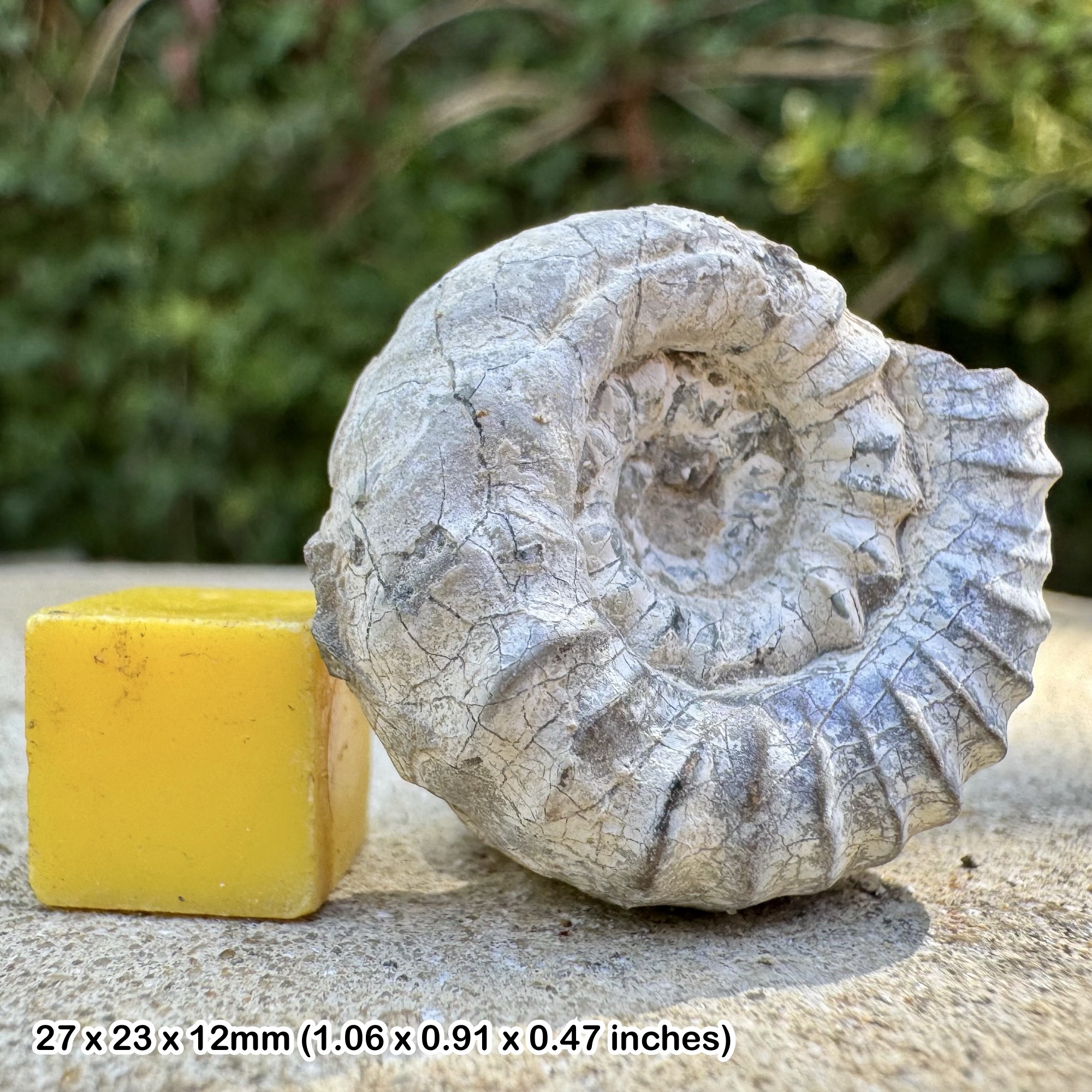
Androgynoceras Ammonite Fossil Jurassic UK Authentic Specimen with Certificate of Authenticity
£ 12.60
ANDROGYNOCERAS AMMONITE FOSSILThis listing offers a fine Androgynoceras Ammonite Fossil, collected from the
Upper Pliensbachian stage of the Early Jurassic at Blockley, Gloucestershire, United Kingdom. This fossil dates to approximately 185–183 million years ago and represents a classic species within the Pliensbachian ammonite faunas. The exact specimen shown in the photographs is the one you will receive, displayed with a 1 cm scale cube for accurate sizing. All fossils are guaranteed genuine and are supplied with a Certificate of Authenticity. GEOLOGICAL CONTEXT – PLIENSBACHIAN OF GLOUCESTERSHIREThe Blockley quarries of Gloucestershire are well known for yielding exceptionally preserved ammonites and other marine fossils from the Lower Jurassic. During the Pliensbachian, this region was covered by shallow epicontinental seas that formed part of the greater Tethyan seaway. Warm, nutrient-rich waters allowed ammonites to flourish alongside belemnites, brachiopods, and marine reptiles.The Upper Pliensbachian is an interval of global geological significance. Its fossil assemblages provide important evidence for the diversity of Early Jurassic marine ecosystems, and the ammonites are crucial for dating and correlating strata. Blockley specimens such as this Androgynoceras are therefore not only collector’s pieces but also key reference points in scientific research. SPECIES OVERVIEW – ANDROGYNOCERASThis ammonite has been identified as belonging to the genus Androgynoceras, part of the order Ammonitida, superfamily Eoderoceratoidea, and family Dactylioceratidae. Members of this genus are noted for their moderately evolute shells and characteristic ribbing patterns.The shell of Androgynoceras typically exhibits strong, regular ribs that may bifurcate or trifurcate as they cross the flanks, giving the fossil a radiating and robust appearance. Its ornamentation is both diagnostic and visually striking, making it a sought-after ammonite for both display and study. The genus is also valuable in biostratigraphy, being used to help define ammonite biozones within the Pliensbachian. PALEONTOLOGICAL IMPORTANCEAmmonites such as Androgynoceras play a central role in biostratigraphy, allowing scientists to identify precise intervals of Jurassic time across different regions. Because of its relatively short stratigraphic range, Androgynoceras serves as a reliable marker fossil for the Upper Pliensbachian.The species also reflects evolutionary trends within the Dactylioceratidae family, including the development of reinforced ribbing and shell geometry that likely aided in protection against predators and buoyancy control. Such features provide insights into both the ecology and adaptive success of ammonites in Early Jurassic seas. COLLECTOR’S AND EDUCATIONAL VALUEThis Androgynoceras ammonite fossil is a fine specimen for any collection of British ammonites or Jurassic fossils. Its provenance from Blockley, Gloucestershire, adds further significance, as the area is historically important to British paleontology.For educators, this ammonite provides an excellent teaching example. Its ribbing and shell form demonstrate ammonite morphology clearly, while its role as a stratigraphic marker illustrates how fossils are used to divide and correlate the geologic record. GUARANTEE OF AUTHENTICITY
• 100% genuine Androgynoceras ammonite fossil
• Supplied with a Certificate of Authenticity
• Exact specimen shown in photographs will be sentThis is a rare opportunity to own a well-preserved Androgynoceras Ammonite Fossil from the Upper Pliensbachian of Blockley, Gloucestershire, United Kingdom, a scientifically significant and highly collectible piece of natural history.
Upper Pliensbachian stage of the Early Jurassic at Blockley, Gloucestershire, United Kingdom. This fossil dates to approximately 185–183 million years ago and represents a classic species within the Pliensbachian ammonite faunas. The exact specimen shown in the photographs is the one you will receive, displayed with a 1 cm scale cube for accurate sizing. All fossils are guaranteed genuine and are supplied with a Certificate of Authenticity. GEOLOGICAL CONTEXT – PLIENSBACHIAN OF GLOUCESTERSHIREThe Blockley quarries of Gloucestershire are well known for yielding exceptionally preserved ammonites and other marine fossils from the Lower Jurassic. During the Pliensbachian, this region was covered by shallow epicontinental seas that formed part of the greater Tethyan seaway. Warm, nutrient-rich waters allowed ammonites to flourish alongside belemnites, brachiopods, and marine reptiles.The Upper Pliensbachian is an interval of global geological significance. Its fossil assemblages provide important evidence for the diversity of Early Jurassic marine ecosystems, and the ammonites are crucial for dating and correlating strata. Blockley specimens such as this Androgynoceras are therefore not only collector’s pieces but also key reference points in scientific research. SPECIES OVERVIEW – ANDROGYNOCERASThis ammonite has been identified as belonging to the genus Androgynoceras, part of the order Ammonitida, superfamily Eoderoceratoidea, and family Dactylioceratidae. Members of this genus are noted for their moderately evolute shells and characteristic ribbing patterns.The shell of Androgynoceras typically exhibits strong, regular ribs that may bifurcate or trifurcate as they cross the flanks, giving the fossil a radiating and robust appearance. Its ornamentation is both diagnostic and visually striking, making it a sought-after ammonite for both display and study. The genus is also valuable in biostratigraphy, being used to help define ammonite biozones within the Pliensbachian. PALEONTOLOGICAL IMPORTANCEAmmonites such as Androgynoceras play a central role in biostratigraphy, allowing scientists to identify precise intervals of Jurassic time across different regions. Because of its relatively short stratigraphic range, Androgynoceras serves as a reliable marker fossil for the Upper Pliensbachian.The species also reflects evolutionary trends within the Dactylioceratidae family, including the development of reinforced ribbing and shell geometry that likely aided in protection against predators and buoyancy control. Such features provide insights into both the ecology and adaptive success of ammonites in Early Jurassic seas. COLLECTOR’S AND EDUCATIONAL VALUEThis Androgynoceras ammonite fossil is a fine specimen for any collection of British ammonites or Jurassic fossils. Its provenance from Blockley, Gloucestershire, adds further significance, as the area is historically important to British paleontology.For educators, this ammonite provides an excellent teaching example. Its ribbing and shell form demonstrate ammonite morphology clearly, while its role as a stratigraphic marker illustrates how fossils are used to divide and correlate the geologic record. GUARANTEE OF AUTHENTICITY
• 100% genuine Androgynoceras ammonite fossil
• Supplied with a Certificate of Authenticity
• Exact specimen shown in photographs will be sentThis is a rare opportunity to own a well-preserved Androgynoceras Ammonite Fossil from the Upper Pliensbachian of Blockley, Gloucestershire, United Kingdom, a scientifically significant and highly collectible piece of natural history.
Other Products