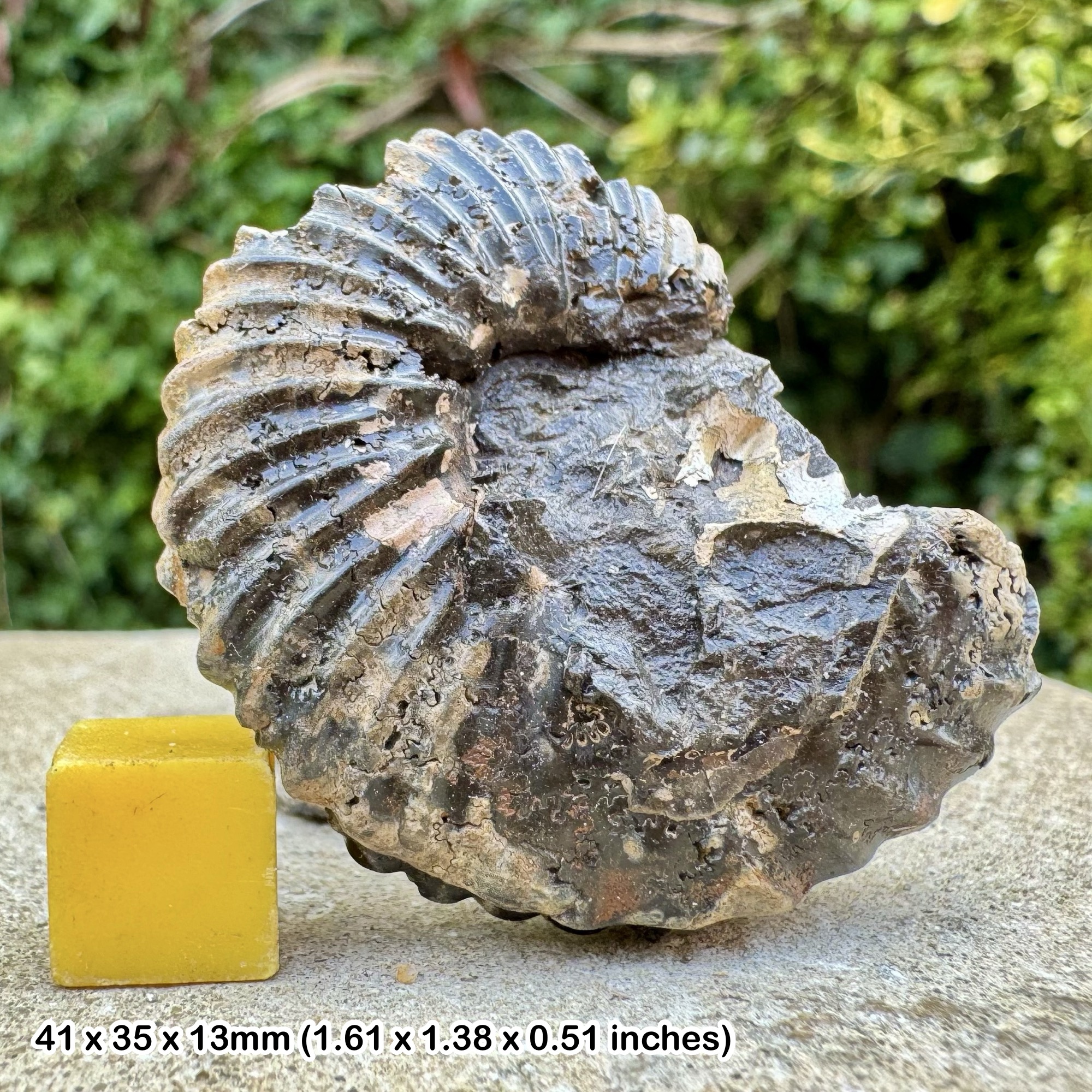
Rare Euhoplites spathi Fossil Ammonite Gault Clay Aptian Cretaceous Folkestone Kent UK with COA
£ 6.90
RARE EUHOPLITES SPATHI FOSSIL AMMONITE FROM FOLKESTONEThis is a rare Euhoplites spathi fossil ammonite, discovered in the famous Gault
Clay Formation at Folkestone, Kent, United Kingdom. The specimen dates to the Aptian Stage of the Lower Cretaceous Period, making it approximately 120–113 million years old. Fossils from this locality are highly prized by collectors due to their historical significance, scientific importance, and rarity.Every ammonite we supply is a 100% genuine specimen and comes with a Certificate of Authenticity. The photographs show the actual specimen you will receive, with a 1cm scale cube and rule squares provided for full sizing reference. GEOLOGICAL AGE AND LOCALITYThe ammonite was recovered from the Gault Clay Formation, a marine deposit exposed along the coast at Folkestone, Kent. The Gault Clay is world-renowned for yielding exceptionally well-preserved fossils from the Lower Cretaceous, particularly ammonites, belemnites, and marine invertebrates.The Aptian Stage represents a time of significant evolutionary diversification in marine life, during which ammonites like Euhoplites flourished in shallow epicontinental seas. Folkestone’s exposures remain one of the classic fossil hunting grounds of the United Kingdom and have been studied extensively by palaeontologists for more than two centuries. FOSSIL TYPE AND SCIENTIFIC CLASSIFICATION
• Genus: Euhoplites
• Species: Euhoplites spathi
• Order: Ammonitida
• Superfamily: Hoplitoidea
• Family: HoplitidaeEuhoplites spathi is an important ammonite species used as an index fossil for correlating Aptian-aged rock strata. Its distinct morphology makes it easily recognisable and valuable both scientifically and for collectors seeking well-documented fossils from stratigraphically significant horizons. MORPHOLOGICAL FEATURESEuhoplites ammonites are noted for their strongly ornamented shells, featuring:
• Evolute Coiling: The whorls are exposed and not deeply overlapping, giving the shell a wide, open appearance.
• Prominent Ribbing: Strong, straight to slightly flexed ribs crossing the shell, adding to its striking texture.
• Tuberculation: Nodes or tubercles often appear along the ribs and keels, providing diagnostic features.
• Keel Development: A narrow keel runs along the venter, a typical trait of the genus.These features made the ammonite hydrodynamically efficient while also serving as key traits for species-level identification by palaeontologists. SCIENTIFIC AND COLLECTOR IMPORTANCEEuhoplites spathi is widely recognised as a biostratigraphically significant ammonite, serving as a marker for precise zonal divisions within the Aptian. For researchers, such fossils offer invaluable insight into ammonite evolution, palaeogeography, and marine environments of the Early Cretaceous.For collectors, this specimen represents not only a rare and beautiful fossil but also a tangible piece of Britain’s palaeontological heritage. Specimens from Folkestone are increasingly scarce due to erosion, collection pressure, and restricted access, making well-preserved examples particularly desirable. DISPLAY AND EDUCATIONAL VALUEThis ammonite specimen has been carefully selected to preserve its diagnostic features, making it suitable for both serious fossil collectors and educational purposes. Its size, shape, and intricate shell ornamentation make it ideal for display in a collection cabinet, study, or museum setting.Owning a rare Euhoplites spathi ammonite from Folkestone connects you directly to the scientific legacy of one of the UK’s most famous fossil localities and to a time when ancient seas teemed with life during the Cretaceous Period. Each piece is completely unique, with natural variation in preservation and detail, ensuring that the fossil you receive is a one-of-a-kind treasure.
Clay Formation at Folkestone, Kent, United Kingdom. The specimen dates to the Aptian Stage of the Lower Cretaceous Period, making it approximately 120–113 million years old. Fossils from this locality are highly prized by collectors due to their historical significance, scientific importance, and rarity.Every ammonite we supply is a 100% genuine specimen and comes with a Certificate of Authenticity. The photographs show the actual specimen you will receive, with a 1cm scale cube and rule squares provided for full sizing reference. GEOLOGICAL AGE AND LOCALITYThe ammonite was recovered from the Gault Clay Formation, a marine deposit exposed along the coast at Folkestone, Kent. The Gault Clay is world-renowned for yielding exceptionally well-preserved fossils from the Lower Cretaceous, particularly ammonites, belemnites, and marine invertebrates.The Aptian Stage represents a time of significant evolutionary diversification in marine life, during which ammonites like Euhoplites flourished in shallow epicontinental seas. Folkestone’s exposures remain one of the classic fossil hunting grounds of the United Kingdom and have been studied extensively by palaeontologists for more than two centuries. FOSSIL TYPE AND SCIENTIFIC CLASSIFICATION
• Genus: Euhoplites
• Species: Euhoplites spathi
• Order: Ammonitida
• Superfamily: Hoplitoidea
• Family: HoplitidaeEuhoplites spathi is an important ammonite species used as an index fossil for correlating Aptian-aged rock strata. Its distinct morphology makes it easily recognisable and valuable both scientifically and for collectors seeking well-documented fossils from stratigraphically significant horizons. MORPHOLOGICAL FEATURESEuhoplites ammonites are noted for their strongly ornamented shells, featuring:
• Evolute Coiling: The whorls are exposed and not deeply overlapping, giving the shell a wide, open appearance.
• Prominent Ribbing: Strong, straight to slightly flexed ribs crossing the shell, adding to its striking texture.
• Tuberculation: Nodes or tubercles often appear along the ribs and keels, providing diagnostic features.
• Keel Development: A narrow keel runs along the venter, a typical trait of the genus.These features made the ammonite hydrodynamically efficient while also serving as key traits for species-level identification by palaeontologists. SCIENTIFIC AND COLLECTOR IMPORTANCEEuhoplites spathi is widely recognised as a biostratigraphically significant ammonite, serving as a marker for precise zonal divisions within the Aptian. For researchers, such fossils offer invaluable insight into ammonite evolution, palaeogeography, and marine environments of the Early Cretaceous.For collectors, this specimen represents not only a rare and beautiful fossil but also a tangible piece of Britain’s palaeontological heritage. Specimens from Folkestone are increasingly scarce due to erosion, collection pressure, and restricted access, making well-preserved examples particularly desirable. DISPLAY AND EDUCATIONAL VALUEThis ammonite specimen has been carefully selected to preserve its diagnostic features, making it suitable for both serious fossil collectors and educational purposes. Its size, shape, and intricate shell ornamentation make it ideal for display in a collection cabinet, study, or museum setting.Owning a rare Euhoplites spathi ammonite from Folkestone connects you directly to the scientific legacy of one of the UK’s most famous fossil localities and to a time when ancient seas teemed with life during the Cretaceous Period. Each piece is completely unique, with natural variation in preservation and detail, ensuring that the fossil you receive is a one-of-a-kind treasure.