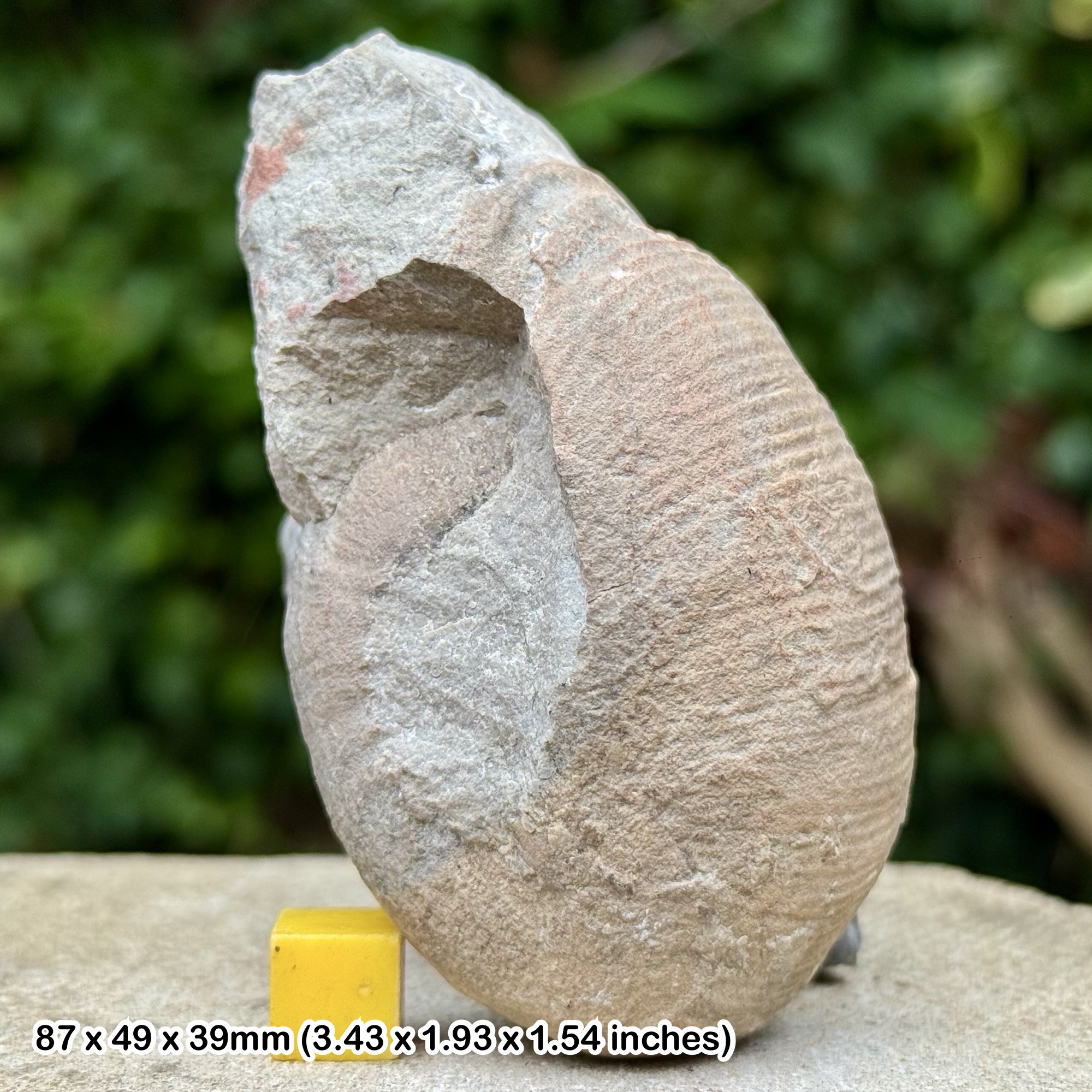
Rare Virgatosphinctes reisi Ammonite Fossil from Lower Tithonian Cretaceous Thorne 06 France Authentic Specimen
£ 36.00
GEOLOGICAL CONTEXT AND PROVENANCEThis rare specimen is a genuine Virgatosphinctes reisi ammonite fossil from the
Lower Tithonian Stage of the Late Jurassic transitioning into the Early Cretaceous, approximately 150 – 145 million years old. It was discovered in Thorne, Alpes-Maritimes, France, a region well known for its richly fossiliferous marine sediments. These deposits represent shallow seas on the margins of the ancient Tethys Ocean, where fine-grained sediments buried and preserved ammonite shells in excellent condition.The Tithonian Stage is a critical interval in Earth’s history, marking the final stage of the Jurassic and bridging into the Cretaceous. Fossils from this period are vital for stratigraphic correlation, providing insights into evolutionary patterns as ecosystems transitioned into the Cretaceous seas. FOSSIL TYPE AND SPECIES INFORMATIONVirgatosphinctes reisi belongs to the Order Ammonitida, Superfamily Perisphinctoidea, and Family Perisphinctidae. Ammonites within this family are widely regarded as important biostratigraphic markers, with their distinctive morphologies enabling precise identification and zonation of Jurassic strata.The genus Virgatosphinctes is recognised for its elegant ribbing and strongly ornamented shells, with reisi being a representative species of the Lower Tithonian. Its restricted stratigraphic range makes it scientifically valuable as an index fossil, widely used in geological studies to define zones within the Tithonian. MORPHOLOGICAL FEATURES AND IDENTIFICATIONThis specimen displays the characteristic features of Virgatosphinctes reisi. The shell is moderately involute, with inner whorls partially covered by later whorls. Strong ribs run across the flanks, often bifurcating, and extend across the venter in a bold and symmetrical pattern. These ribs are evenly spaced, creating a striking visual effect that is distinctive to this genus.The ribbing served structural and functional purposes, reinforcing the shell against external pressure while contributing to hydrodynamic efficiency. Like other ammonites, Virgatosphinctes had a chambered shell filled with gas and fluid, which allowed buoyancy control and vertical movement in the water column. DEPOSITIONAL ENVIRONMENTDuring the Lower Tithonian, the Thorne area of southeastern France was part of a shallow subtropical sea influenced by the Tethys Ocean. The marine environment was highly productive, hosting a diverse array of invertebrates, including ammonites, belemnites, gastropods, and bivalves. Larger marine reptiles such as ichthyosaurs and pliosaurs also inhabited these waters, preying upon ammonites and other nektonic organisms.Sediments from this region primarily consist of marls and limestones, deposited under relatively calm marine conditions, which promoted the exceptional preservation of ammonite shells. The abundance and diversity of ammonites in these deposits make them crucial for reconstructing Jurassic–Cretaceous ecosystems. COLLECTOR APPEAL AND AUTHENTICITYThis Virgatosphinctes reisi ammonite fossil is a rare and scientifically important specimen. Its sharp ribbing, elegant coiling, and provenance from the classic Lower Tithonian beds of Thorne, France, make it highly desirable to collectors, educators, and researchers alike.
• 100% Genuine Specimen – Supplied with a Certificate of Authenticity.
• Exact Fossil Shown – The images provided show the actual specimen you will receive.
• Scale Reference – Scale rule squares / cube = 1 cm. Please see photos for full sizing.This carefully chosen Virgatosphinctes reisi ammonite fossil embodies both the beauty and scientific importance of Late Jurassic ammonites. With its rarity, well-preserved ribbing, and geological significance, it represents an exceptional addition to any fossil collection or natural history display.
Lower Tithonian Stage of the Late Jurassic transitioning into the Early Cretaceous, approximately 150 – 145 million years old. It was discovered in Thorne, Alpes-Maritimes, France, a region well known for its richly fossiliferous marine sediments. These deposits represent shallow seas on the margins of the ancient Tethys Ocean, where fine-grained sediments buried and preserved ammonite shells in excellent condition.The Tithonian Stage is a critical interval in Earth’s history, marking the final stage of the Jurassic and bridging into the Cretaceous. Fossils from this period are vital for stratigraphic correlation, providing insights into evolutionary patterns as ecosystems transitioned into the Cretaceous seas. FOSSIL TYPE AND SPECIES INFORMATIONVirgatosphinctes reisi belongs to the Order Ammonitida, Superfamily Perisphinctoidea, and Family Perisphinctidae. Ammonites within this family are widely regarded as important biostratigraphic markers, with their distinctive morphologies enabling precise identification and zonation of Jurassic strata.The genus Virgatosphinctes is recognised for its elegant ribbing and strongly ornamented shells, with reisi being a representative species of the Lower Tithonian. Its restricted stratigraphic range makes it scientifically valuable as an index fossil, widely used in geological studies to define zones within the Tithonian. MORPHOLOGICAL FEATURES AND IDENTIFICATIONThis specimen displays the characteristic features of Virgatosphinctes reisi. The shell is moderately involute, with inner whorls partially covered by later whorls. Strong ribs run across the flanks, often bifurcating, and extend across the venter in a bold and symmetrical pattern. These ribs are evenly spaced, creating a striking visual effect that is distinctive to this genus.The ribbing served structural and functional purposes, reinforcing the shell against external pressure while contributing to hydrodynamic efficiency. Like other ammonites, Virgatosphinctes had a chambered shell filled with gas and fluid, which allowed buoyancy control and vertical movement in the water column. DEPOSITIONAL ENVIRONMENTDuring the Lower Tithonian, the Thorne area of southeastern France was part of a shallow subtropical sea influenced by the Tethys Ocean. The marine environment was highly productive, hosting a diverse array of invertebrates, including ammonites, belemnites, gastropods, and bivalves. Larger marine reptiles such as ichthyosaurs and pliosaurs also inhabited these waters, preying upon ammonites and other nektonic organisms.Sediments from this region primarily consist of marls and limestones, deposited under relatively calm marine conditions, which promoted the exceptional preservation of ammonite shells. The abundance and diversity of ammonites in these deposits make them crucial for reconstructing Jurassic–Cretaceous ecosystems. COLLECTOR APPEAL AND AUTHENTICITYThis Virgatosphinctes reisi ammonite fossil is a rare and scientifically important specimen. Its sharp ribbing, elegant coiling, and provenance from the classic Lower Tithonian beds of Thorne, France, make it highly desirable to collectors, educators, and researchers alike.
• 100% Genuine Specimen – Supplied with a Certificate of Authenticity.
• Exact Fossil Shown – The images provided show the actual specimen you will receive.
• Scale Reference – Scale rule squares / cube = 1 cm. Please see photos for full sizing.This carefully chosen Virgatosphinctes reisi ammonite fossil embodies both the beauty and scientific importance of Late Jurassic ammonites. With its rarity, well-preserved ribbing, and geological significance, it represents an exceptional addition to any fossil collection or natural history display.
Other Products