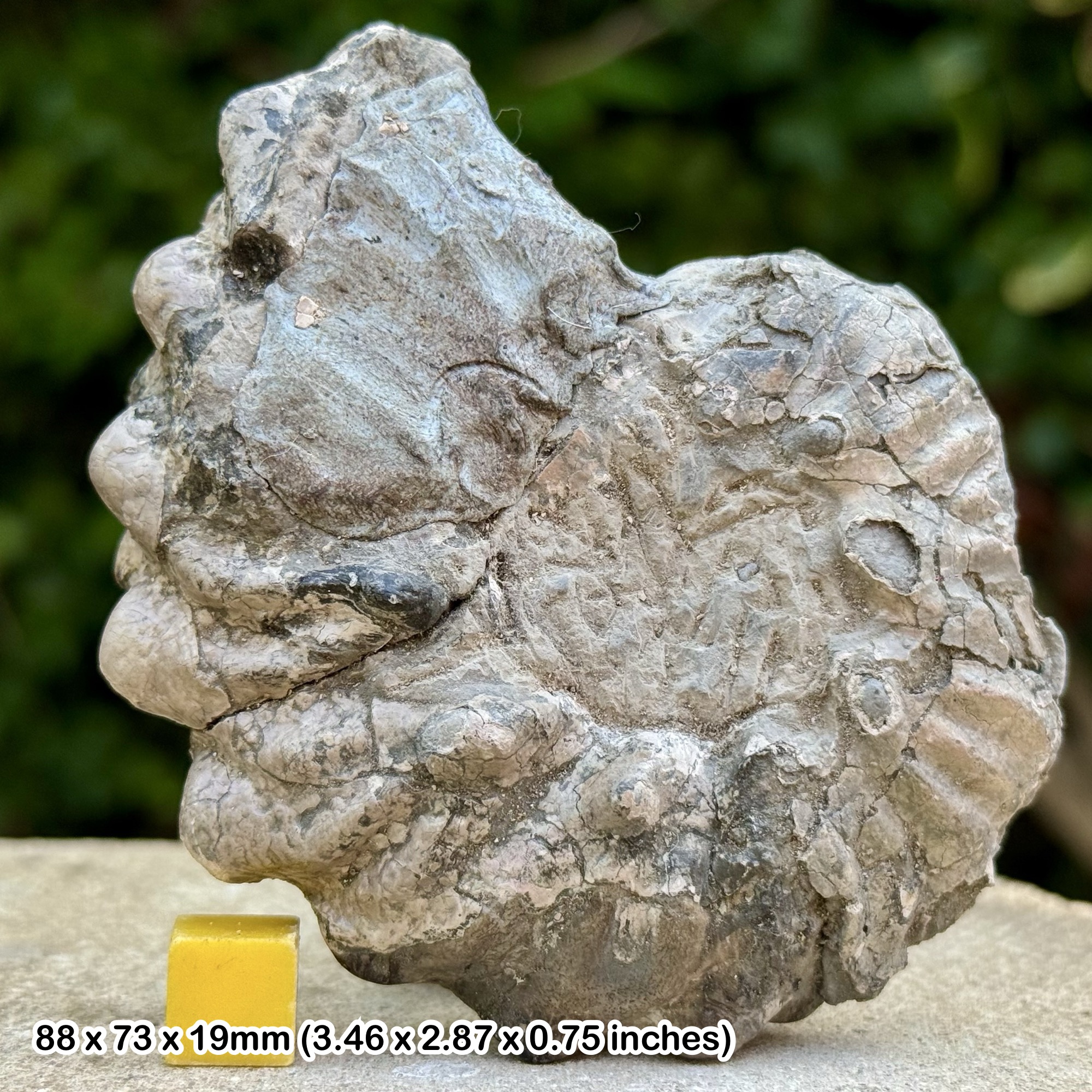
RARE Protohoplites Puzosia archianus Fossil Ammonite Gault Clay Aptian Cretaceous Folkestone Kent UK Specimen
£ 14.40
RARE PROTOHOPLITES (PUZOSIA) ARCHIANUS FOSSIL AMMONITE FROM FOLKESTONEThis listing presents a rare Protohoplites (Puzosia) archianus fossil ammonite
discovered in the Gault Clay Formation at Folkestone, Kent, United Kingdom. Dating to the Aptian stage of the Early Cretaceous Period (approximately 125–113 million years ago), this ammonite is both scientifically significant and highly collectible. Its association with one of England’s most celebrated fossil localities makes it an exceptional acquisition for collectors and researchers alike.All of our fossils are 100% genuine specimens, and this piece comes complete with a Certificate of Authenticity. The exact ammonite shown in the photographs is the one you will receive, with a 1 cm scale cube and rule squares included to provide accurate size reference. GEOLOGICAL CONTEXT AND FORMATIONThe Gault Clay Formation is a marine sedimentary unit laid down in a shallow sea connected to the ancient Tethys Ocean. It represents a key stratigraphic horizon in the Aptian to Albian stages of the Early Cretaceous. Known worldwide for its abundance of ammonites, belemnites, bivalves, and other marine fossils, the Gault Clay is of immense scientific importance in stratigraphy and palaeontology.Specimens of Protohoplites (Puzosia) archianus are uncommon, making this piece especially valuable. Their occurrence in the Folkestone Gault Clay allows geologists to correlate Aptian sediments across Europe, highlighting their role as biostratigraphic markers. MORPHOLOGY AND DISTINCTIVE FEATURESProtohoplites (Puzosia) archianus belongs to the family Desmoceratidae, within the order Ammonitida. Its shell is typically involute and moderately compressed, with strong ribbing that crosses the flanks and continues across the venter. The ribs may be straight or gently flexed, giving the shell a bold and sculptured appearance.The venter is often keeled, providing hydrodynamic efficiency as the animal moved through the water. This feature, combined with its ribbing pattern, allows easy identification of the species compared to other ammonites of the Aptian. The well-preserved sutures and symmetry enhance both its scientific and aesthetic appeal. SCIENTIFIC IMPORTANCEProtohoplites (Puzosia) archianus is a fossil of great biostratigraphic significance, being tied to specific intervals of the Aptian stage. Its distinct morphology allows researchers to establish and correlate zones within the Gault Clay and other equivalent deposits across Europe and beyond.Its evolutionary position is also noteworthy: the genus Puzosia is part of a lineage that continued to flourish throughout the Cretaceous, with descendants persisting well into the Late Cretaceous. This makes the species a key piece in understanding ammonite development and diversification. COLLECTOR AND DISPLAY VALUEThis specimen of Protohoplites (Puzosia) archianus combines rarity, historical provenance, and visual appeal. The Folkestone Gault Clay is one of the most famous fossil localities in the world, and ammonites from this site have long been prized by collectors. The strong ribbing and classic ammonite form make this a striking display piece, while its scientific significance ensures lasting value.For private collectors, museums, or educational displays, this fossil represents an outstanding addition. Its rarity ensures that it will stand out in any collection focused on ammonites, British fossils, or Cretaceous palaeontology. YOUR GUARANTEE OF AUTHENTICITY
• 100% genuine Protohoplites (Puzosia) archianus ammonite fossil
• Geological age: Aptian stage, Early Cretaceous (approx. 125–113 million years ago)
• Formation: Gault Clay Formation, Folkestone, Kent, United Kingdom
• Family: Desmoceratidae, Order: Ammonitida
• Distinctive features: involute form, ribbed shell, keeled venter
• Exact specimen shown in the photographs (not a stock image)
• Supplied with a Certificate of Authenticity
• Scale cube and rule squares = 1 cm for precise measurementThis rare Protohoplites (Puzosia) archianus ammonite is a scientifically valuable and visually impressive specimen, offering the opportunity to own a piece of England’s Early Cretaceous marine history.
discovered in the Gault Clay Formation at Folkestone, Kent, United Kingdom. Dating to the Aptian stage of the Early Cretaceous Period (approximately 125–113 million years ago), this ammonite is both scientifically significant and highly collectible. Its association with one of England’s most celebrated fossil localities makes it an exceptional acquisition for collectors and researchers alike.All of our fossils are 100% genuine specimens, and this piece comes complete with a Certificate of Authenticity. The exact ammonite shown in the photographs is the one you will receive, with a 1 cm scale cube and rule squares included to provide accurate size reference. GEOLOGICAL CONTEXT AND FORMATIONThe Gault Clay Formation is a marine sedimentary unit laid down in a shallow sea connected to the ancient Tethys Ocean. It represents a key stratigraphic horizon in the Aptian to Albian stages of the Early Cretaceous. Known worldwide for its abundance of ammonites, belemnites, bivalves, and other marine fossils, the Gault Clay is of immense scientific importance in stratigraphy and palaeontology.Specimens of Protohoplites (Puzosia) archianus are uncommon, making this piece especially valuable. Their occurrence in the Folkestone Gault Clay allows geologists to correlate Aptian sediments across Europe, highlighting their role as biostratigraphic markers. MORPHOLOGY AND DISTINCTIVE FEATURESProtohoplites (Puzosia) archianus belongs to the family Desmoceratidae, within the order Ammonitida. Its shell is typically involute and moderately compressed, with strong ribbing that crosses the flanks and continues across the venter. The ribs may be straight or gently flexed, giving the shell a bold and sculptured appearance.The venter is often keeled, providing hydrodynamic efficiency as the animal moved through the water. This feature, combined with its ribbing pattern, allows easy identification of the species compared to other ammonites of the Aptian. The well-preserved sutures and symmetry enhance both its scientific and aesthetic appeal. SCIENTIFIC IMPORTANCEProtohoplites (Puzosia) archianus is a fossil of great biostratigraphic significance, being tied to specific intervals of the Aptian stage. Its distinct morphology allows researchers to establish and correlate zones within the Gault Clay and other equivalent deposits across Europe and beyond.Its evolutionary position is also noteworthy: the genus Puzosia is part of a lineage that continued to flourish throughout the Cretaceous, with descendants persisting well into the Late Cretaceous. This makes the species a key piece in understanding ammonite development and diversification. COLLECTOR AND DISPLAY VALUEThis specimen of Protohoplites (Puzosia) archianus combines rarity, historical provenance, and visual appeal. The Folkestone Gault Clay is one of the most famous fossil localities in the world, and ammonites from this site have long been prized by collectors. The strong ribbing and classic ammonite form make this a striking display piece, while its scientific significance ensures lasting value.For private collectors, museums, or educational displays, this fossil represents an outstanding addition. Its rarity ensures that it will stand out in any collection focused on ammonites, British fossils, or Cretaceous palaeontology. YOUR GUARANTEE OF AUTHENTICITY
• 100% genuine Protohoplites (Puzosia) archianus ammonite fossil
• Geological age: Aptian stage, Early Cretaceous (approx. 125–113 million years ago)
• Formation: Gault Clay Formation, Folkestone, Kent, United Kingdom
• Family: Desmoceratidae, Order: Ammonitida
• Distinctive features: involute form, ribbed shell, keeled venter
• Exact specimen shown in the photographs (not a stock image)
• Supplied with a Certificate of Authenticity
• Scale cube and rule squares = 1 cm for precise measurementThis rare Protohoplites (Puzosia) archianus ammonite is a scientifically valuable and visually impressive specimen, offering the opportunity to own a piece of England’s Early Cretaceous marine history.
Other Products