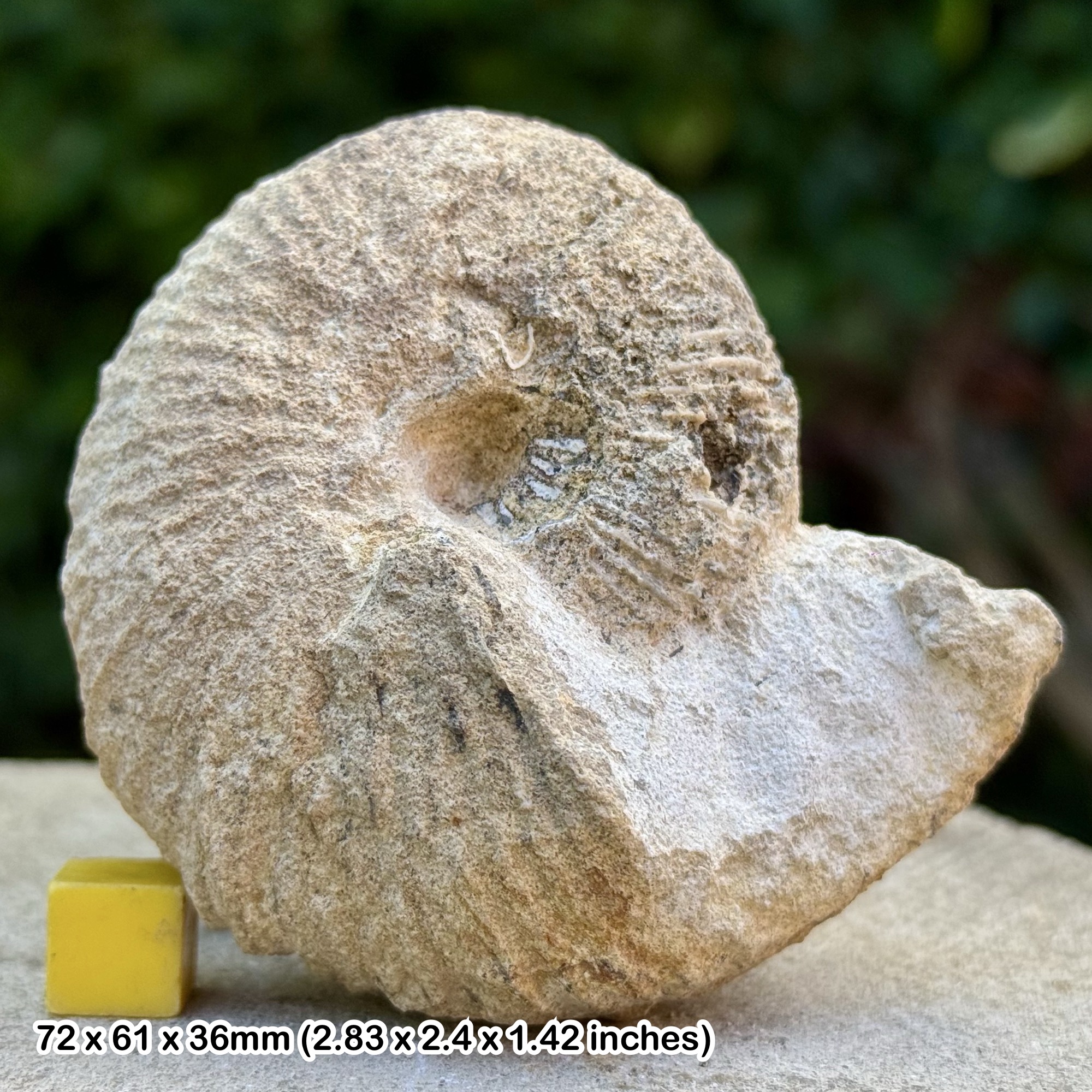
Macrocephalites macrocephalus Ammonite Fossil Jurassic Shorncote Quarry UK Genuine COA
£ 24.00
AUTHENTIC JURASSIC FOSSIL FROM GLOUCESTERSHIRE, UKThis Macrocephalites macrocephalus ammonite fossil is a genuine specimen from
the Upper Cornbrash Formation, dating to the Callovian stage of the Middle Jurassic, discovered at Shorncote Quarry in Gloucestershire, United Kingdom. It has been carefully selected for its excellent preservation and striking morphology, making it both a scientifically significant fossil and an exceptional collector’s piece. The photographs show the exact specimen you will receive, with a 1 cm scale cube for accurate sizing. Each fossil is supplied with a Certificate of Authenticity, guaranteeing that it is 100% genuine. GEOLOGICAL AGE AND PROVENANCEThe specimen comes from the Upper Cornbrash, a fossiliferous limestone unit within the Callovian stage, approximately 166–163 million years old. The Cornbrash Formation is renowned across central and southern England for its abundance of marine fossils, particularly ammonites. At the time of deposition, the region was submerged beneath shallow, warm seas forming part of the extensive Tethyan marine system. Fine-grained sediments provided ideal conditions for fossilisation, resulting in the preservation of ammonites, bivalves, brachiopods, and marine reptiles. Shorncote Quarry is one of the most important Callovian sites in Gloucestershire, contributing greatly to scientific understanding of Jurassic stratigraphy. SPECIES IDENTIFICATION AND CLASSIFICATIONMacrocephalites macrocephalus belongs to the class Cephalopoda, order Ammonitida, superfamily Stephanoceratoidea, and family Macrocephalitidae. The genus Macrocephalites is one of the most distinctive ammonite groups of the Callovian, recognised for its large, compressed shells and prominent ribbing. The species macrocephalus is particularly important as a zonal index fossil, used by geologists to define and correlate horizons within the Callovian stage. Its presence in the Cornbrash Formation provides a key biostratigraphic marker for correlating Jurassic marine sediments across Europe. MORPHOLOGY AND DISTINCTIVE TRAITSThis specimen shows the characteristic features of Macrocephalites macrocephalus. The shell is planispiral and strongly compressed, with tightly coiled whorls and distinct ribbing that crosses the flanks symmetrically. The ribs are bold and regular, often bifurcating towards the ventral area, giving the fossil a striking appearance. The compressed form of the whorls reflects adaptations for stability and hydrodynamics within its marine environment. Its size, symmetry, and ribbing pattern make macrocephalus one of the most easily recognisable Callovian ammonites. SCIENTIFIC AND STRATIGRAPHIC IMPORTANCEMacrocephalites macrocephalus is of great significance in Jurassic stratigraphy. Its distribution across Europe makes it an excellent index fossil for the Lower Callovian, and its occurrence within the Cornbrash Formation is critical for defining biozones. Ammonites such as this are fundamental for establishing the geological timescale, as they evolved rapidly and had wide geographic ranges. For collectors, this fossil represents not only a beautiful specimen but also a key piece of evidence in the history of paleontological research. CONDITION AND PRESENTATIONThe fossil has been carefully prepared to highlight its natural details, with ribbing, whorl structure, and compressed form clearly visible. It is a unique specimen, not a replica or cast. The photographs provided are of the actual ammonite you will receive, ensuring full transparency and authenticity. Its well-preserved morphology makes it suitable both for display and as an educational or research specimen. GUARANTEE OF AUTHENTICITYAll of our fossils are 100% genuine, responsibly sourced, and scientifically identified. Each specimen comes with a Certificate of Authenticity. This Macrocephalites macrocephalus ammonite fossil from Shorncote Quarry, Gloucestershire, is a rare and scientifically valuable example of Callovian ammonites, making it an outstanding addition for fossil collectors, natural history enthusiasts, and academic collections.
the Upper Cornbrash Formation, dating to the Callovian stage of the Middle Jurassic, discovered at Shorncote Quarry in Gloucestershire, United Kingdom. It has been carefully selected for its excellent preservation and striking morphology, making it both a scientifically significant fossil and an exceptional collector’s piece. The photographs show the exact specimen you will receive, with a 1 cm scale cube for accurate sizing. Each fossil is supplied with a Certificate of Authenticity, guaranteeing that it is 100% genuine. GEOLOGICAL AGE AND PROVENANCEThe specimen comes from the Upper Cornbrash, a fossiliferous limestone unit within the Callovian stage, approximately 166–163 million years old. The Cornbrash Formation is renowned across central and southern England for its abundance of marine fossils, particularly ammonites. At the time of deposition, the region was submerged beneath shallow, warm seas forming part of the extensive Tethyan marine system. Fine-grained sediments provided ideal conditions for fossilisation, resulting in the preservation of ammonites, bivalves, brachiopods, and marine reptiles. Shorncote Quarry is one of the most important Callovian sites in Gloucestershire, contributing greatly to scientific understanding of Jurassic stratigraphy. SPECIES IDENTIFICATION AND CLASSIFICATIONMacrocephalites macrocephalus belongs to the class Cephalopoda, order Ammonitida, superfamily Stephanoceratoidea, and family Macrocephalitidae. The genus Macrocephalites is one of the most distinctive ammonite groups of the Callovian, recognised for its large, compressed shells and prominent ribbing. The species macrocephalus is particularly important as a zonal index fossil, used by geologists to define and correlate horizons within the Callovian stage. Its presence in the Cornbrash Formation provides a key biostratigraphic marker for correlating Jurassic marine sediments across Europe. MORPHOLOGY AND DISTINCTIVE TRAITSThis specimen shows the characteristic features of Macrocephalites macrocephalus. The shell is planispiral and strongly compressed, with tightly coiled whorls and distinct ribbing that crosses the flanks symmetrically. The ribs are bold and regular, often bifurcating towards the ventral area, giving the fossil a striking appearance. The compressed form of the whorls reflects adaptations for stability and hydrodynamics within its marine environment. Its size, symmetry, and ribbing pattern make macrocephalus one of the most easily recognisable Callovian ammonites. SCIENTIFIC AND STRATIGRAPHIC IMPORTANCEMacrocephalites macrocephalus is of great significance in Jurassic stratigraphy. Its distribution across Europe makes it an excellent index fossil for the Lower Callovian, and its occurrence within the Cornbrash Formation is critical for defining biozones. Ammonites such as this are fundamental for establishing the geological timescale, as they evolved rapidly and had wide geographic ranges. For collectors, this fossil represents not only a beautiful specimen but also a key piece of evidence in the history of paleontological research. CONDITION AND PRESENTATIONThe fossil has been carefully prepared to highlight its natural details, with ribbing, whorl structure, and compressed form clearly visible. It is a unique specimen, not a replica or cast. The photographs provided are of the actual ammonite you will receive, ensuring full transparency and authenticity. Its well-preserved morphology makes it suitable both for display and as an educational or research specimen. GUARANTEE OF AUTHENTICITYAll of our fossils are 100% genuine, responsibly sourced, and scientifically identified. Each specimen comes with a Certificate of Authenticity. This Macrocephalites macrocephalus ammonite fossil from Shorncote Quarry, Gloucestershire, is a rare and scientifically valuable example of Callovian ammonites, making it an outstanding addition for fossil collectors, natural history enthusiasts, and academic collections.
Other Products