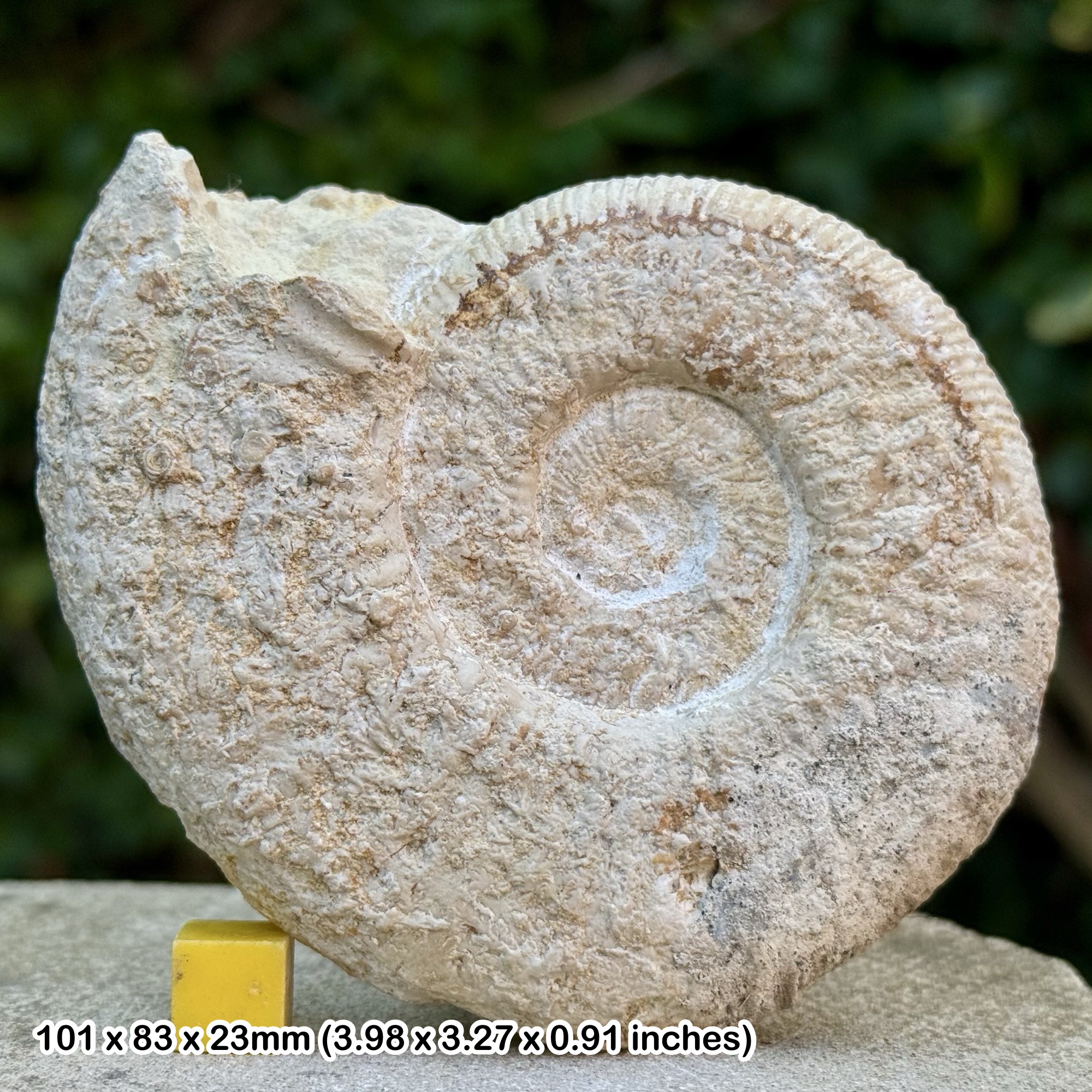
Fossil Ammonite Macrocephalites jacquoti Lower Callovian Jurassic Bourges France with Certificate of Authenticity
£ 24.00
GENUINE FOSSIL AMMONITE FROM FRANCEThis listing is for a genuine fossil ammonite, Macrocephalites jacquoti,
discovered in the Jurassic deposits of Bourges, France. Dating to the Lower Callovian stage of the Middle Jurassic (approximately 166–163 million years ago), this specimen is a carefully selected example from one of Europe’s most important ammonite-bearing localities. The fossil shown in the photographs is the exact one you will receive, chosen for its quality and preservation. Scale rule squares / cube = 1 cm – please see photos for accurate sizing. All of our fossils are 100% genuine specimens, supplied with a Certificate of Authenticity for peace of mind. GEOLOGICAL CONTEXT: LOWER CALLOVIAN STAGEThe Callovian stage represents an important division of the Middle Jurassic, characterised by widespread marine transgressions and the flourishing of ammonite faunas. In the Bourges region of central France, marine sediments of the Callovian include clays, marls, and limestones deposited in a shallow epicontinental sea connected to the Tethys Ocean. These conditions were highly favourable for the preservation of ammonites and other marine invertebrates.The Lower Callovian is particularly significant because ammonites from this interval are used to define biostratigraphic zones across Europe. Fossils such as Macrocephalites jacquoti are vital for dating and correlating Jurassic rock sequences, making them scientifically important reference points. THE SPECIES: MACROCEPHALITES JACQUOTIMacrocephalites jacquoti belongs to the order Ammonitida, superfamily Perisphinctoidea, and family Macrocephalitidae. The genus Macrocephalites is notable for its large, strongly ribbed shells, often with compressed whorls and ornamentation that makes it highly recognisable among Jurassic ammonites.The shell of M. jacquoti typically shows robust ribbing across its whorls, giving the fossil a distinctive sculptural appearance. Its morphology indicates an active nektonic lifestyle, with the animal swimming in open marine waters, preying on smaller marine organisms such as crustaceans and juvenile molluscs.As a diagnostic species of the Lower Callovian, Macrocephalites jacquoti is an index fossil used to establish the relative age of marine sediments within this stage, making it essential to Jurassic biostratigraphy. MORPHOLOGICAL AND SCIENTIFIC FEATURES
• Order: Ammonitida
• Superfamily: Perisphinctoidea
• Family: Macrocephalitidae
• Genus and Species: Macrocephalites jacquoti
• Geological Stage: Lower Callovian, Middle Jurassic (c. 166–163 Ma)
• Locality: Bourges, France
• Shell Traits: Large planispiral coiling, strong ribbing, compressed whorls, distinctive ornamentation
• Significance: Important index fossil for the Lower Callovian biozonesThe diagnostic ribbing and size of Macrocephalites jacquoti make it a key ammonite for stratigraphic studies and an attractive collector’s fossil. Its well-preserved structure also provides insight into the evolutionary adaptations of Middle Jurassic ammonites. COLLECTOR AND DISPLAY VALUEAmmonites are among the most collectible fossils, and specimens of Macrocephalites jacquoti from Bourges are especially sought after due to their scientific and display value. Their historical importance as index fossils, combined with their robust ribbed shells, make them ideal for both research and private collections.This specimen from Bourges is a fine example of a Callovian ammonite, providing a tangible link to marine ecosystems that flourished over 160 million years ago. Its preservation and provenance make it an outstanding addition for collectors, educators, or anyone interested in natural history.All of our fossils are carefully selected, fully authentic, and come with a Certificate of Authenticity, ensuring you receive a genuine specimen of Earth’s prehistoric past.
discovered in the Jurassic deposits of Bourges, France. Dating to the Lower Callovian stage of the Middle Jurassic (approximately 166–163 million years ago), this specimen is a carefully selected example from one of Europe’s most important ammonite-bearing localities. The fossil shown in the photographs is the exact one you will receive, chosen for its quality and preservation. Scale rule squares / cube = 1 cm – please see photos for accurate sizing. All of our fossils are 100% genuine specimens, supplied with a Certificate of Authenticity for peace of mind. GEOLOGICAL CONTEXT: LOWER CALLOVIAN STAGEThe Callovian stage represents an important division of the Middle Jurassic, characterised by widespread marine transgressions and the flourishing of ammonite faunas. In the Bourges region of central France, marine sediments of the Callovian include clays, marls, and limestones deposited in a shallow epicontinental sea connected to the Tethys Ocean. These conditions were highly favourable for the preservation of ammonites and other marine invertebrates.The Lower Callovian is particularly significant because ammonites from this interval are used to define biostratigraphic zones across Europe. Fossils such as Macrocephalites jacquoti are vital for dating and correlating Jurassic rock sequences, making them scientifically important reference points. THE SPECIES: MACROCEPHALITES JACQUOTIMacrocephalites jacquoti belongs to the order Ammonitida, superfamily Perisphinctoidea, and family Macrocephalitidae. The genus Macrocephalites is notable for its large, strongly ribbed shells, often with compressed whorls and ornamentation that makes it highly recognisable among Jurassic ammonites.The shell of M. jacquoti typically shows robust ribbing across its whorls, giving the fossil a distinctive sculptural appearance. Its morphology indicates an active nektonic lifestyle, with the animal swimming in open marine waters, preying on smaller marine organisms such as crustaceans and juvenile molluscs.As a diagnostic species of the Lower Callovian, Macrocephalites jacquoti is an index fossil used to establish the relative age of marine sediments within this stage, making it essential to Jurassic biostratigraphy. MORPHOLOGICAL AND SCIENTIFIC FEATURES
• Order: Ammonitida
• Superfamily: Perisphinctoidea
• Family: Macrocephalitidae
• Genus and Species: Macrocephalites jacquoti
• Geological Stage: Lower Callovian, Middle Jurassic (c. 166–163 Ma)
• Locality: Bourges, France
• Shell Traits: Large planispiral coiling, strong ribbing, compressed whorls, distinctive ornamentation
• Significance: Important index fossil for the Lower Callovian biozonesThe diagnostic ribbing and size of Macrocephalites jacquoti make it a key ammonite for stratigraphic studies and an attractive collector’s fossil. Its well-preserved structure also provides insight into the evolutionary adaptations of Middle Jurassic ammonites. COLLECTOR AND DISPLAY VALUEAmmonites are among the most collectible fossils, and specimens of Macrocephalites jacquoti from Bourges are especially sought after due to their scientific and display value. Their historical importance as index fossils, combined with their robust ribbed shells, make them ideal for both research and private collections.This specimen from Bourges is a fine example of a Callovian ammonite, providing a tangible link to marine ecosystems that flourished over 160 million years ago. Its preservation and provenance make it an outstanding addition for collectors, educators, or anyone interested in natural history.All of our fossils are carefully selected, fully authentic, and come with a Certificate of Authenticity, ensuring you receive a genuine specimen of Earth’s prehistoric past.
Other Products