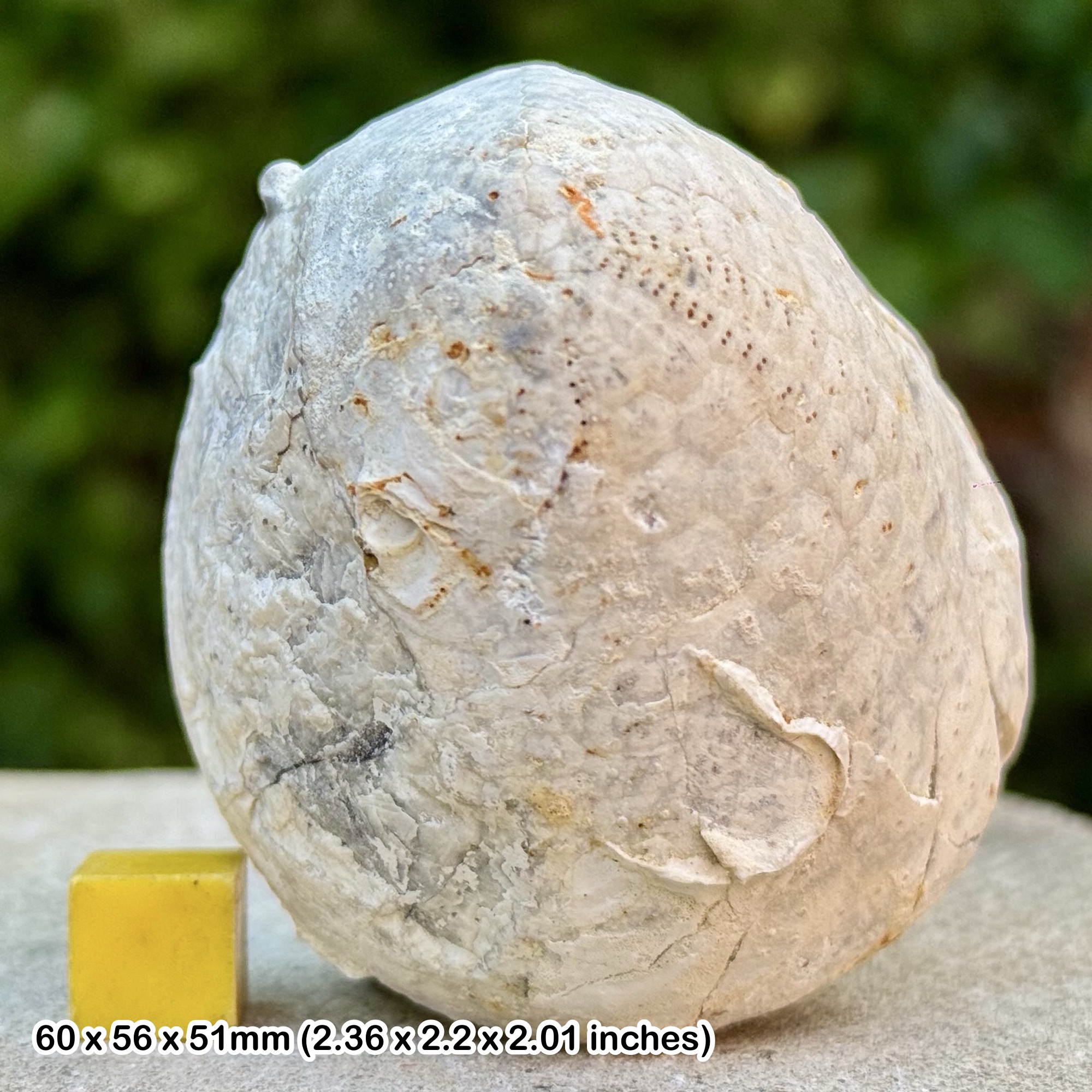
Echinocorys conicus Fossil Echinoid in Flint Cretaceous Wiltshire UK Genuine Chalk Sea Fossil with Certificate of Authenticity
£ 24.00
Offered here is a remarkable Echinocorys conicus fossil echinoid in flint from
the Cretaceous Chalk deposits of Wiltshire, UK. This species is one of the most iconic irregular echinoids from the Late Cretaceous seas of Europe, preserved in fine detail within flint nodules formed millions of years ago. The specimen presented is the exact one shown in the photographs, with a 1 cm scale cube included for accurate measurement.All of our fossils are 100% genuine specimens and are supplied with a Certificate of Authenticity, ensuring both their authenticity and scientific value. GEOLOGICAL CONTEXT: CRETACEOUS CHALK AND FLINTDuring the Cretaceous period (approximately 100–66 million years ago), much of southern England, including Wiltshire, was covered by a warm, shallow epicontinental sea. The seabed was dominated by the remains of coccolithophores—microscopic algae whose calcareous plates accumulated to form the Chalk.Flint nodules, such as the one encasing this echinoid, formed within the Chalk through the mobilization and concentration of silica, derived from the skeletons of marine organisms such as sponges and radiolarians. Over millions of years, this silica hardened into flint, often preserving fossils in exquisite three-dimensional detail. SPECIES OVERVIEW: ECHINOCORYS CONICUS
• Phylum: Echinodermata
• Class: Echinoidea
• Order: Holasteroida
• Family: Holasteridae
• Genus: Echinocorys
• Species: Echinocorys conicusThis species, commonly referred to as the “cone-shaped heart urchin,” is characterised by its conical, domed test with a tapering apex. Unlike regular echinoids, Echinocorys conicus displayed bilateral symmetry, an adaptation for a burrowing lifestyle within soft carbonate sediments. MORPHOLOGICAL FEATURES AND ADAPTATIONSKey traits of Echinocorys conicus include:
• A conical, elongate test with a high dome compared to related species.
• A well-developed anterior groove to aid in sediment displacement and feeding.
• Ambulacral areas forming a faint petaloid structure on the test’s surface.
• Reduced spines, as this species was adapted for life buried beneath the seafloor.These features mark it as a deposit-feeding infaunal echinoid, living within the Chalk seabed and filtering organic material from sediments. SCIENTIFIC AND COLLECTOR IMPORTANCESpecimens of Echinocorys conicus preserved in flint are highly desirable due to the durability and fine preservation afforded by the silica matrix. They provide valuable evidence of evolutionary adaptations among echinoids during the Late Cretaceous and are frequently used as index fossils for biostratigraphic correlation.For collectors, this fossil represents a striking display piece with both scientific and aesthetic value. Its robust preservation within flint ensures that it will remain stable and visually impressive for generations. PROVENANCE AND AUTHENTICITYThis specimen was sourced from Wiltshire, UK, a region renowned for its rich Cretaceous fossil heritage. It has been carefully chosen, cleaned, and prepared to display its features clearly. As with all our fossils, it is accompanied by a Certificate of Authenticity.This Echinocorys conicus fossil echinoid in flint is an exceptional example of Britain’s Cretaceous Chalk sea life, combining both scientific importance and collector appeal.
the Cretaceous Chalk deposits of Wiltshire, UK. This species is one of the most iconic irregular echinoids from the Late Cretaceous seas of Europe, preserved in fine detail within flint nodules formed millions of years ago. The specimen presented is the exact one shown in the photographs, with a 1 cm scale cube included for accurate measurement.All of our fossils are 100% genuine specimens and are supplied with a Certificate of Authenticity, ensuring both their authenticity and scientific value. GEOLOGICAL CONTEXT: CRETACEOUS CHALK AND FLINTDuring the Cretaceous period (approximately 100–66 million years ago), much of southern England, including Wiltshire, was covered by a warm, shallow epicontinental sea. The seabed was dominated by the remains of coccolithophores—microscopic algae whose calcareous plates accumulated to form the Chalk.Flint nodules, such as the one encasing this echinoid, formed within the Chalk through the mobilization and concentration of silica, derived from the skeletons of marine organisms such as sponges and radiolarians. Over millions of years, this silica hardened into flint, often preserving fossils in exquisite three-dimensional detail. SPECIES OVERVIEW: ECHINOCORYS CONICUS
• Phylum: Echinodermata
• Class: Echinoidea
• Order: Holasteroida
• Family: Holasteridae
• Genus: Echinocorys
• Species: Echinocorys conicusThis species, commonly referred to as the “cone-shaped heart urchin,” is characterised by its conical, domed test with a tapering apex. Unlike regular echinoids, Echinocorys conicus displayed bilateral symmetry, an adaptation for a burrowing lifestyle within soft carbonate sediments. MORPHOLOGICAL FEATURES AND ADAPTATIONSKey traits of Echinocorys conicus include:
• A conical, elongate test with a high dome compared to related species.
• A well-developed anterior groove to aid in sediment displacement and feeding.
• Ambulacral areas forming a faint petaloid structure on the test’s surface.
• Reduced spines, as this species was adapted for life buried beneath the seafloor.These features mark it as a deposit-feeding infaunal echinoid, living within the Chalk seabed and filtering organic material from sediments. SCIENTIFIC AND COLLECTOR IMPORTANCESpecimens of Echinocorys conicus preserved in flint are highly desirable due to the durability and fine preservation afforded by the silica matrix. They provide valuable evidence of evolutionary adaptations among echinoids during the Late Cretaceous and are frequently used as index fossils for biostratigraphic correlation.For collectors, this fossil represents a striking display piece with both scientific and aesthetic value. Its robust preservation within flint ensures that it will remain stable and visually impressive for generations. PROVENANCE AND AUTHENTICITYThis specimen was sourced from Wiltshire, UK, a region renowned for its rich Cretaceous fossil heritage. It has been carefully chosen, cleaned, and prepared to display its features clearly. As with all our fossils, it is accompanied by a Certificate of Authenticity.This Echinocorys conicus fossil echinoid in flint is an exceptional example of Britain’s Cretaceous Chalk sea life, combining both scientific importance and collector appeal.