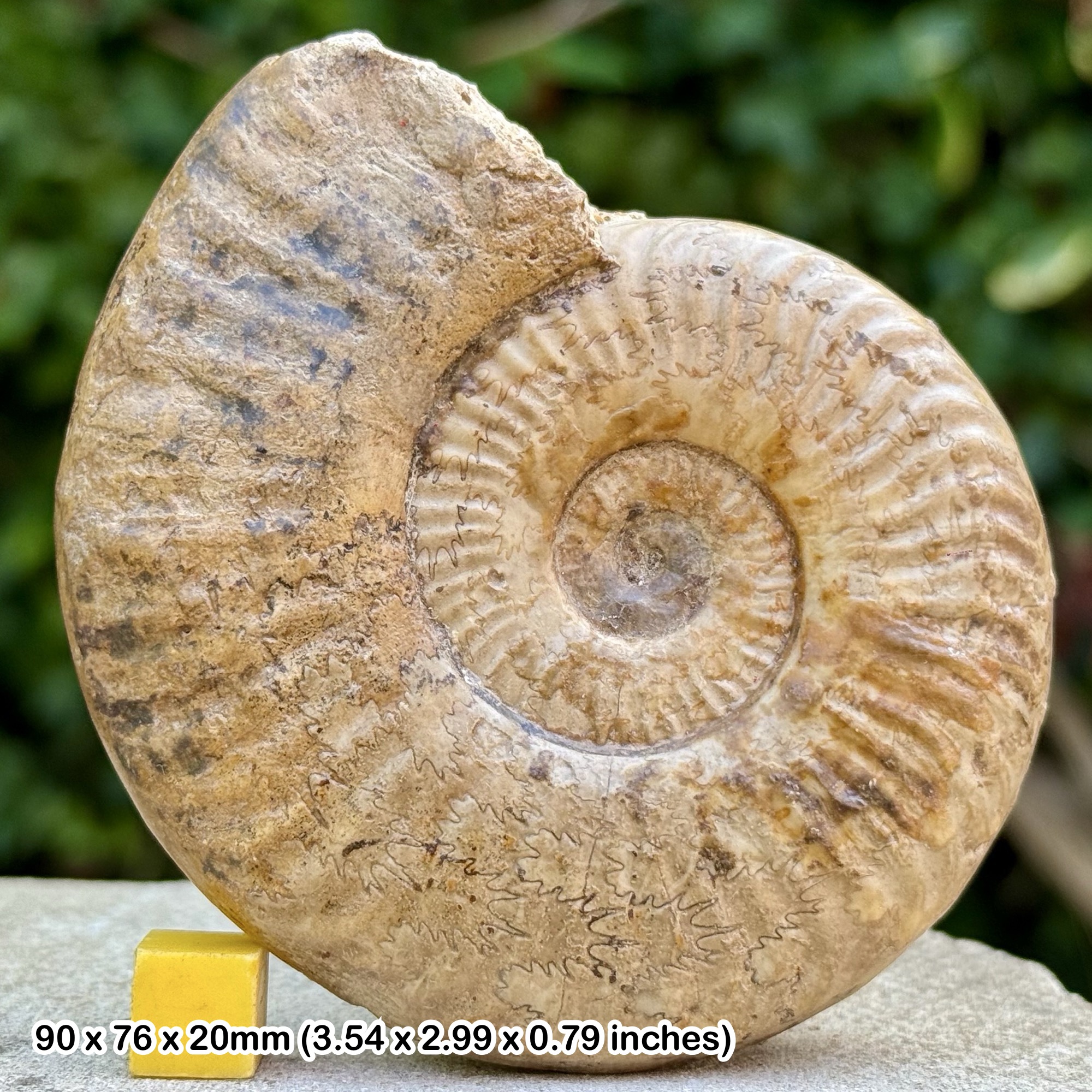
Grammoceras Ammonite Fossil from Upper Toarcian Jurassic Calvados France with Certificate of Authenticity
£ 36.00
GEOLOGICAL CONTEXTThis authentic Grammoceras ammonite fossil originates from the Upper Toarcian
Stage of the Jurassic Period, approximately 182 to 174 million years old. It was discovered in Calvados, France, a region renowned for its rich Jurassic marine deposits. During the Toarcian, this area was submerged beneath the warm, shallow waters of the Tethys Ocean, creating an ideal environment for ammonites and other marine organisms to flourish. The finely layered limestones and shales of this region are particularly famous for producing beautifully preserved cephalopod fossils. TAXONOMIC CLASSIFICATION
• Kingdom: Animalia
• Phylum: Mollusca
• Class: Cephalopoda
• Order: Ammonitida
• Superfamily: Hildoceratoidea
• Family: Hildoceratidae
• Genus: GrammocerasThe genus Grammoceras is a key taxon within Jurassic ammonites, often used by palaeontologists as an index fossil for stratigraphic dating and correlation of Toarcian deposits worldwide. MORPHOLOGICAL FEATURESThis fossilised ammonite displays the classic characteristics of the genus Grammoceras:
• A flat, discoidal shell with tightly coiled whorls.
• Fine, radial ribbing extending across the flanks, producing a delicate but distinctive ornamentation.
• A relatively compressed form, giving the fossil an elegant, streamlined appearance.
• Evidence of the complex suture pattern typical of ammonites, highlighting the intricate chamber structure within the shell.These features not only reflect the evolutionary adaptations of Jurassic ammonites but also make Grammoceras highly sought after by collectors. DEPOSITIONAL ENVIRONMENTThe ammonite was preserved in marine sedimentary rocks of the Upper Toarcian, often associated with black shales and fine-grained limestones. These deposits indicate a low-energy marine basin environment, where fine sediments accumulated in oxygen-poor conditions. Such settings are excellent for fossil preservation, allowing delicate shell details to remain intact for nearly 180 million years. The Calvados region is particularly significant for palaeontologists, as its stratigraphy provides a window into Jurassic marine ecosystems along the northern margin of the Tethys Ocean. SCIENTIFIC AND COLLECTOR SIGNIFICANCE
• Biostratigraphic Importance: Grammoceras species are valuable for correlating Toarcian deposits across Europe.
• Evolutionary Insight: Represents a stage in ammonite evolution where shell compression and ribbing were highly developed.
• Collector’s Appeal: Its well-defined ribbing, elegant profile, and rarity make it a desirable specimen for both private and museum collections.
• Educational Use: An excellent teaching aid for understanding Jurassic marine life and ammonite morphology. AUTHENTICITY AND PRESENTATION
• Supplied with a Certificate of Authenticity guaranteeing it as a 100% genuine fossil specimen.
• The fossil shown in the photographs is the exact piece you will receive, ensuring transparency and uniqueness.
• Scale reference is provided in the photos, with 1 cm cube markings to allow precise size assessment.This remarkable Grammoceras ammonite fossil from the Upper Toarcian of Calvados, France, is both scientifically significant and visually striking. It embodies a key moment in Jurassic palaeontology and offers collectors the chance to own a rare and authentic piece of Earth’s history, preserved for nearly 180 million years.
Stage of the Jurassic Period, approximately 182 to 174 million years old. It was discovered in Calvados, France, a region renowned for its rich Jurassic marine deposits. During the Toarcian, this area was submerged beneath the warm, shallow waters of the Tethys Ocean, creating an ideal environment for ammonites and other marine organisms to flourish. The finely layered limestones and shales of this region are particularly famous for producing beautifully preserved cephalopod fossils. TAXONOMIC CLASSIFICATION
• Kingdom: Animalia
• Phylum: Mollusca
• Class: Cephalopoda
• Order: Ammonitida
• Superfamily: Hildoceratoidea
• Family: Hildoceratidae
• Genus: GrammocerasThe genus Grammoceras is a key taxon within Jurassic ammonites, often used by palaeontologists as an index fossil for stratigraphic dating and correlation of Toarcian deposits worldwide. MORPHOLOGICAL FEATURESThis fossilised ammonite displays the classic characteristics of the genus Grammoceras:
• A flat, discoidal shell with tightly coiled whorls.
• Fine, radial ribbing extending across the flanks, producing a delicate but distinctive ornamentation.
• A relatively compressed form, giving the fossil an elegant, streamlined appearance.
• Evidence of the complex suture pattern typical of ammonites, highlighting the intricate chamber structure within the shell.These features not only reflect the evolutionary adaptations of Jurassic ammonites but also make Grammoceras highly sought after by collectors. DEPOSITIONAL ENVIRONMENTThe ammonite was preserved in marine sedimentary rocks of the Upper Toarcian, often associated with black shales and fine-grained limestones. These deposits indicate a low-energy marine basin environment, where fine sediments accumulated in oxygen-poor conditions. Such settings are excellent for fossil preservation, allowing delicate shell details to remain intact for nearly 180 million years. The Calvados region is particularly significant for palaeontologists, as its stratigraphy provides a window into Jurassic marine ecosystems along the northern margin of the Tethys Ocean. SCIENTIFIC AND COLLECTOR SIGNIFICANCE
• Biostratigraphic Importance: Grammoceras species are valuable for correlating Toarcian deposits across Europe.
• Evolutionary Insight: Represents a stage in ammonite evolution where shell compression and ribbing were highly developed.
• Collector’s Appeal: Its well-defined ribbing, elegant profile, and rarity make it a desirable specimen for both private and museum collections.
• Educational Use: An excellent teaching aid for understanding Jurassic marine life and ammonite morphology. AUTHENTICITY AND PRESENTATION
• Supplied with a Certificate of Authenticity guaranteeing it as a 100% genuine fossil specimen.
• The fossil shown in the photographs is the exact piece you will receive, ensuring transparency and uniqueness.
• Scale reference is provided in the photos, with 1 cm cube markings to allow precise size assessment.This remarkable Grammoceras ammonite fossil from the Upper Toarcian of Calvados, France, is both scientifically significant and visually striking. It embodies a key moment in Jurassic palaeontology and offers collectors the chance to own a rare and authentic piece of Earth’s history, preserved for nearly 180 million years.
Other Products